
Showing posts with label Acer. Show all posts
Showing posts with label Acer. Show all posts
Sunday, October 24, 2010
The Pink Underbelly of Red Maple, Acer rubrum
Red Maple is one of the most vividly colorful trees in the fall. Sometime take a look at the underside of the leaves - very often they turn a soft, pastel pink. Flash photography brings out detail, but it fails to capture the subtle color and beauty on the underside of this leaf.


Sunday, March 21, 2010
Northern Indiana Update
Upon returning home to northern Indiana from sunny and green Florida, I was hopeful that spring had arrived in my absence. Not the case, but at least there's no snow! I haven't been out botanizing, but the only plant in bloom on our property is Acer saccharinum (Silver Maple).
_3-21-2010_Home.JPG)
_3-21-2010_Home.JPG)
Some flowers of Acer saccharinum are perfect, but others are fully pistillate (like those above) or fully staminate (like some of those shown below).+2_3-21-2010_Home.JPG)
Wednesday, December 2, 2009
Interesting Little Forest
Does this young forest look mundane? Uninteresting?
It’s quite the opposite!
 At a fraction of an acre, it occupies a little corner in a long-abandoned ag field in St. Joe County, Indiana – out of cultivation for at least 30 years. Most of the surrounding land is yellow clay at the surface, and forests in the vicinity are Beech-Sugar Maple. But this little corner is dominated by Red Maple, with occasional Black Cherry and Sassafras on a sandy substrate. Unlike other Red Maple forests, this one is not in a low lying flat, but upland. The sand is almost certainly underlain with clay, keeping moisture at the surface for long periods of time.
When Red Maple forests aren’t too shady the herbaceous vegetation can be pretty exciting, especially if you like ferns, club mosses, and sedges. I first botanized this site in 1997 and found hundreds of Daisyleaf Grape Ferns (Botrychium matricariaefolium).

In 2008 I was startled to find Downy Rattlesnake Plantain (Goodyera pubescens) and Spotted Wintergreen (Chimaphila maculata).
Downy Rattlesnake Plantain Orchid (Goodyera pubescens)

Spotted Wintergreen (Chimaphila maculata)

Last week I went there to photograph Botrychium dissectum and its segregates and was fortunate to see a tiny Spiranthes orchid in seed. Its identification is guesswork, but diminutive Spiranthes ovalis is a possibility.


On the same visit I saw the lovely Shining Club Moss (Lycopodium lucidulum)!
 Interestingly, the club moss was growing right at the base of a tree where water gets funneled when it rains. If you’ve never observed this, it’s worth donning a rain suit and going into the forest while it’s raining. All of the water that doesn’t drip from a tree’s limbs or get absorbed by the bark gets funneled right down the trunk, and even during moderate rain, water comes gushing down. Some plants take advantage of this. For example, Spinulose Wood Fern (Dryopteris spinulosa) will grow anywhere in mesic and wet forests, but in dryer sites it survives at the base of tree trunks. Watch for this – it’s a common sight, at least in northern Indiana. Dryopteris intermedia does this too, as shown in this photo from Warren Woods in Michigan. We should keep this in mind when doing native landscaping. And we should never pass up a chance to botanize a Red Maple forest!
Florist's Fern (Dryopteris intermedia)

Sunday, March 29, 2009
Acer rubrum, Red Maple - Beautiful in Every Season
One of the most beloved trees of wet forests - Red Maple - is also one of the nicest yard trees we can have, even in uplands. Here are photos from Saturday of pistillate (female) flowers, staminate (male) flowers, and from last October, autumn leaves. Photos from Chamberlain Lake and Ambler Flatwoods nature preserves in northern Indiana.


Friday, October 10, 2008
Unusual Trees
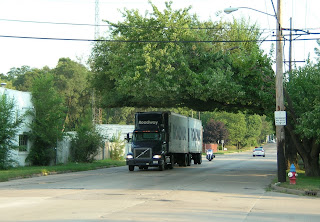
The silver maple (Acer saccharinum) reaches out over South Olive Street in South Bend, Indiana. The oak (Quercus sp.) was on a county road south of South Bend. I believe it's gone now.


Subscribe to:
Posts (Atom)