Showing posts with label Plant Quiz. Show all posts

Thursday, June 26, 2014

Plant Quiz - Answer

I recently posted the following plant quiz...
 
----------
Anyone able to ID this plant from what is shown in this photograph? 


----------

There were several good guesses, and BOUCUR got the genus correct (Valeriana), but no one figured out the species.  Here is what it would have looked like in flower...


This is Valeriana uliginosa (Marsh Valerian), a species of fens primarily in the Great Lakes region. Because of its rarity, V. uliginosa is a species of conservation concern in most of the states in which it occurs.  In the quiz photo, the "plumose pappus-like" structures are actually the calyx lobes, which are inrolled when the plant is in flower and expanded when it goes to fruit. 

Thursday, February 6, 2014

Plant Quiz - Answered

I recently posted the following plant quiz...
 
----------
 
Hopefully you haven't forgotten about us here at Get Your Botany On!  Sorry for the long delay between posts.  Here's a quick plant quiz to hold you over until our next more lengthy post.  Good luck!
 

----------

The Phytophactor answered correctly that this plant is Geocaulon lividum of the family Santalaceae.  Like other members of this family, False Toadflax, as this species is known, is a hemiparasite that produces haustoria that attach to roots of host plants to obtain a portion of its nutrients. 

Geocaulon lividum
Geocaulon lividum is a northern species found throughout much of Canada and Alaska, barely reaching into the contiguous United States.  Because of this geographical distribution, it is a species of conservation concern in several states.  It grows in wet to moist conditions, such as in bogs, fens, and coniferous or deciduous forests, but also on sandy or rocky ridges or dunes near the Great Lakes.  The genus name Geocaulon means "earth" (Geo-) and "stem of the plant" (-caulon), which is a reference to the long slightly subterranean stems (rhizomes).  The specific epithet lividum means "lead-colored," which could be a reference to the flowers, which range from green to purple in color.

Geocaulon lividum
Geocaulon lividum has been treated as a member of the genus Comandra (Comandra lividum), and anyone familiar with the genus Comandra can easily see why.  It differs from Comandra in having green to purple flowers (versus white in Comandra), axillary inflorescences (versus terminal in Comandra), and orange-red fruit more than 7 mm in diameter (versus green to yellowish fruit up to 6 mm in diameter in Comandra).  In each cymule on a Geocaulon lividum plant, the central flower is perfect, whereas the other one to two flowers are staminate; Comandra has all flowers perfect in each cymule.  For comparison, Comandra umbellata is pictured below.  Vegetatively, Geocaulon lividum may be confused with a member of the genus Vaccinium, which would have woody stems and leaves with different venation and texture.

Comandra umbellata
The photographs of Geocaulon lividum above were taken on June 22, 2013 in Copper Harbor, Michigan.  Nice call, Phytophactor!

Monday, October 28, 2013

Plant Quiz - Answered

I recently posted the following plant quiz...
 
----------
Been a while... how about a cropped photo plant quiz?
 

Good luck!
----------

Ben and DenPro both correctly responded that this is a close-up of Clematis virginiana, Virgin's Bower.  Here's the original photo, prior to being cropped...

Note the plumose styles of Clematis virginiana in fruit.
... and here's another photo showing the feathery inflorescences made up of numerous plumose styles when the plant is in fruit.  Like most plants I've noticed this fall, Clematis virginiana seemed to flower and fruit profusely this year.

The dense inflorescence of Clematis virginiana in fruit.
During the summer, Clematis virginiana looks like this, a vine with flowers in axillary panicles, each with four white to cream-colored petaloid sepals, no petals, and numerous pistils in female flowers and stamens in male flowers.  The leaves are compound, often with three leaflets, each of which is toothed on the margins. The similar looking Clematis ternifolia, an invasive species from Asia, has five leaflets that are entire or merely crenate on the margins.

Clematis virginiana in flower.
Clematis virginiana grows in moist thickets, in wooded and open floodplains, and along fencerows throughout the eastern half of North America.  Taxonomically, it is placed in the family Ranunculaceae.

Nice job, Ben and DenPro!

Sunday, December 23, 2012

Green in Winter: Common Speedwell

The text and picture below were posted earlier as a plant quiz. The plant was correctly named by Scott as Veronica officinalis, Common Speedwell. Good call, Scott!   This attractive little garden escape has a definite preference for dry, eroded clay slopes in partial shade. 

Posted previously: This plant was growing on a forested clay slope in St. Joseph County, Indiana. Do you recognize it? Feel free to name it or just take a guess. Good luck!

Saturday, November 10, 2012

Do You Know This Plant?

I recently posted the following as a plant quiz...
 
--------------------
I've taken a lot of photos this year, and I hope at some point I'll be able to catch up on posting some of them here and at Through Handlens and Binoculars.  In the meantime, here is a fun plant quiz.  Good luck!
 
--------------------
 
As Ben said, the plant looks very "Pedicularis-ish," but A.L. noticed the inflated calyx with four lobes and correctly identified the plant in the photo as Rhinanthus minor.  Based on the whitish teeth on the corolla and the lines of hairs on two sides of the stem, as well as the mostly dentate leaves, I would call this Rhinanthus minor ssp. groenlandicus based on the most current understanding of the species.  Like other plants in the Orobanchaceae, this species is a hemi-parasite that can sometimes obtain nutrients from the roots of nearby plants.   "Rhinanthus" means "snout-flower," a reference to the nose-like appearance of the flowers.
 

Yellow Rattle, as it is commonly known because of the rattling sound made by the seeds within the inflated calyx when the fruit matures, grows in a wide variety of open habitats, ranging from wet to dry.  It sometimes grows in calcareous situations.  In this instance, Bruce Behan and I found it growing in moist shallow soil in an open area within a sandstone pavement community in Clinton County, New York. 

 
There is apparently some disagreement on whether or not Rhinanthus minor is native in New York.  Some authors consider it native in most of Canada and in the Pacific Northwest, as well as in one county in New Hampshire, but non-native throughout the rest of its range in the United States.  Other authors seem to consider it to be native where it occurs in the United States.
 
Congratulations, A.L., on correctly identifying the plant in this plant quiz!

Wednesday, October 3, 2012

Time for a Plant Quiz - Answered

I recently posted the following plant quiz...
 
--------------------
It's been a busy year.  I'm behind on publishing blog posts and I'm not really sure where to start catching up, so in the meantime, here's a plant quiz.  Good luck!   
 
--------------------
 
Anonymous and The Phytophactor both correctly identified this as the flower of Proboscidea louisianica, formerly known as Martynia louisianica.  This odd, conspicuous species is considered by some to be a member of the family Pedaliaceae (the sesame family) and by others to be in the family Martyniaceae (the unicorn plant family).
 

I was alerted of the presence of this plant in St. Joseph County, Indiana by a colleague who sent me a couple of photos of an unknown squash-like plant that showed up on the property of a friend of his.  I later found out that the plant was growing at the edge of a tilled vegetable garden.  The landowner, who has lived there many years, has never seen the plant before and did not plant it, at least intentionally.  I have doubts that this is truly a spontaneous occurrence; I wonder if there were seeds of this species accidentally included in the garden vegetable seeds that were installed in the garden.  In Flora of Indiana, Charlie Deam mentions that he once found this species introduced with strawberries that had been seeded in a garden.


In its native range, which seems centered in Texas, New Mexico, Oklahoma, Kansas, and Colorado (but that ranges into scattered counties throughout much of the United States), Proboscidea louisianaca grows along streambanks and in waste areas.   I can't imagine seeing this species growing as part of a natural community.  It was apparently once a part of the native flora in Indiana (along the Ohio and Wabash rivers), but it is now considered extirpated from the state.

 
The fruit of Proboscidea louisianica are also quite unique and are the source of the common names Ram's Horn, Unicorn Plant, and Devil's Claw.  This species is sometimes cultivated so that the fruit can be pickled.  As The Phytophactor pointed out, mucilaginous hairs cover Proboscidea louisianica... and all members of the Martyniaceae and Pedaliaceae. 
 
Good call, Anonymous and The Phytophactor!
 
--------------------
 
Note: Since posting the answer to this quiz, Kay Yatskievych has let me know that the correct spelling of the epithet for this species is actually "louisiana," making the correct name of this plant Proboscidea louisiana.  In addition, Kay is aware of records in Indiana from Hendricks, Jefferson, Wells, and now St. Joseph counties in Indiana; one of those records is from a weedy area near a bird feeder, so bird food may be another source of the spread of this species.

Sunday, May 13, 2012

Ranunculus bulbosus, Bulbous Buttercup

Three cheers for DenPro! On March 22 I posted this photo of a vegetative plant I didn't recognize, hoping someone would be able to name it. To me it looked like Artemisia, and there were a lot of suggestions in different families and genera. DenPro suggested some kind of Ranunculus, and today I discovered he was right!
Good call - it is Ranunculus bulbosus, not recorded from the 11,000 square mile Chicago Region since the days of Julius Nieuwland! Discovered in disturbed, gravelly clay waste ground at the St. Joseph County Fairgrounds, South Bend, Indiana. Note the white clover in the upper right corner for scale. This plant has not been mowed.
Finding something new is always fun, even if it's a weed. For the rest of the day's botanizing trip I was champing at the bit to get home to my books and microscope!

"Weeds are flowers too, once you get to know them." Eeyore

Saturday, May 12, 2012

Plant Quiz - Answered!

I recently posted the following plant quiz...

----------
The photograph below was taken in St. Joseph County, Indiana.  This should be an easy one, given that pretty much the entire plant is present in the photo...


Good luck!
----------

It doesn't take long for an answer to a plant quiz on Get Your Botany On!, and this time EMP correctly answered with Ellisia nyctelea. This member of the Hydrophyllaceae (waterleaf family) is an annual that grows in mesic forests as well as in disturbed areas where little competition from other species is present.  In Indiana, Aunt Lucy, as it is known, was previously documented from a few western counties.  I was shocked when I saw it in a forest in St. Joseph County along the St. Joseph River.  Luckily, Keith Board was home that Saturday afternoon when I called him from the field, and he was able to look up its known distribution so that I knew to collect it as a new county record.

Congratulation on correctly answering the quiz, EMP!

Sunday, May 6, 2012

Plant Quiz Solved - Large-flowered Valerian!

Good Call, A.L. and M.Y.O.Q. It is Valeriana pauciflora. It is interesting to note that “pauciflora” means few-flowered, but the common name is Large-flowered Valerian. This native plant has a limited distribution in North America, but can be locally abundant where it occurs. Maps on the USDA Plants database seem to show that Indiana has more known locations than other states in the plant’s limited range. These were abundant in low, rich woods along the Salamonie River in the Kokiwanee Nature Preserve, Wabash County, Indiana.


Do you recognize this plant? Without seeing leaves, identification is much more challenging. Feel free to name it or just take a guess! It was growing in shaded, wet woods.

Saturday, April 21, 2012

Plant Quiz Solved - Thlaspi perfoliatum!

Good call Scott! It is Thlaspi perfoliatum, Small Pennycress, with auriculate-clasping (not perfoliate) leaves on the stem. Some are now calling this Microthlaspi perfoliatum.


Do you recognize this little weed? Feel free to identify it or just take a guess! Photographed in St. Joseph County, Indiana on April 19, 2012.

Wednesday, April 18, 2012

Plant Quiz Solved - German Knotgrass!

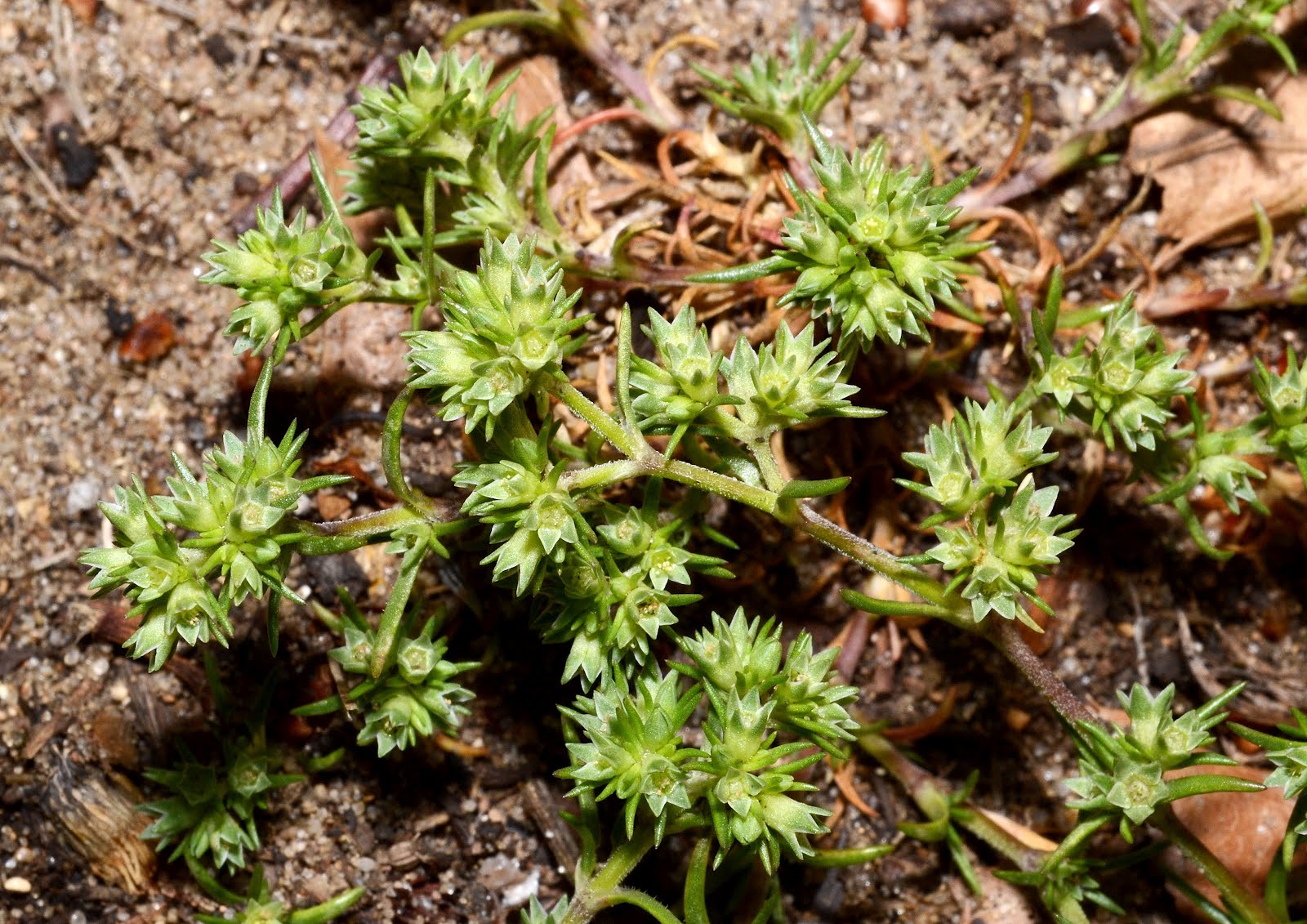
Good call Johnny Hank, it is Scleranthus annuus, German Knotgrass or "Knawel." This small and easily overlooked plant grows all over North America in dry sand and gravelly places. It is not native here. The flowers are green and "apetalous" (without petals), and it's a member of the Caryophyllaceae (Pink Family). Just as the common name says, it is "not grass."


Can you name this plant? Feel free to name it or just take a guess. Good luck!

Thursday, March 22, 2012

Plant Quiz

Does anyone recognize this plant? I don't know what it is, but hopefully some of you can provide a name. It's not aromatic at all, but is it an Artemisia? It grows in vacant lots in South Bend, Indiana and is probably a garden escape, but I don't study cultivated plants. I seem to recall seeing it in flower beds somewhere.

Thanks!

Saturday, March 3, 2012

Green in Winter: Plant Quiz Solved! Blephilia hirsuta

Good call Nate! It is Blephilia hirsuta, Wood Mint. This plant is often associated with alluvial soils and slopes in mesic woodland. The leaves have a very appealing aroma when crushed.

Posted previously:
This plant was photographed on a slope above the Eel River in Miami County, Indiana in mid-February, 2012. Can you identify it? Feel free to name the plant or just take a guess!

Friday, February 24, 2012

Plant Quiz Solved! Black Locust, Robinia pseudo-acacia

Good call, A.L.! It is Robinia pseudo-acacia, Black Locust. This is an impressive looking tree when it matures, but it is said to have nitrogen-fixing bacteria in root nodules and as a result, it inhibits the growth of many other plants (Google "Allelopathy"). Young trees (and young branches on older trees) have small but very sharp spines. The lower bark on mature trees is VERY deeply furrowed and distinctive (see below). This is why the lower trunk was cropped away from the plant quiz photo!
-----------------------------------------
Can you identify this tree just by its distinctive shape? Good luck! Please feel free to ID the tree or just take a guess. Photographed in St. Joe County, Indiana.

Tuesday, February 21, 2012

Plant Quiz Solved! - Tree Bark - Gleditsia triacanthos

Good call A.L. and Tom! It is Gleditsia triacanthos, Honey Locust. This is the native tree that normally has large, stout, branched spines all over the trunk. This tree had them, but they were up higher on the trunk. In Indiana it grows in forested bottomlands, but is not very common in the northern third of the state. The unarmed cultivar of this tree (var. inermis) is used extensively in landscaping, especially where large leaves would be a problem on sidewalks, etc.
--------------

Can you identify this tree just by the bark? Feel free to name the tree or just take a guess! Photographed in central Indiana.

Sunday, February 12, 2012

Green in Winter: Bearberry - Plant Quiz

Good call Kim! It is Arctostaphylos uva-ursi, Bearberry. In Indiana, this plant is frequent near Lake Michigan in the dune country. Photographed in Porter County, Indiana on February 11, 2012.
------

Can you identify this plant? It is green (and sometimes reddish) in winter. Good luck!

Friday, January 20, 2012

Green in Winter: Plant Quiz - Phlox divaricata

Good call, Scott! It is Phlox divaricata, Woodland Phlox, a common native plant in Midwestern forests.

Posted earlier: This plant shows up occasionally in mesic forests in winter. Barbara Plampin, Myrna Newgent and I used to see it as we explored the forests of northern Indiana on winter outings. We disagreed on its identification, so eventually I marked a colony and returned to it in the spring. Barbara had the identification correct - no surprise there! Can you name the plant? Feel free to name it or just take a guess.

This is how it looked in May, 2009 near Dowagiac, Michigan.

"Is not January the hardest month to get through? When you have weathered that, you get into the gulf stream of winter, nearer the shores of spring." Henry David Thoreau Journal, February 2, 1854.

Friday, January 13, 2012

Green in Winter: Monarda punctata, Plant Quiz Solved!

Congratulations to Andrew "The Commander" Blackburn for correctly identifying the winter leaves of Monarda punctata, Horse Mint. A common plant of dry sand in the dunes region of Indiana, this attractive mint produces pale yellow flowers with magenta spots (punctata = dotted). Upper bracts of the plant are pale pinkish or lavender and get a lot more attention than the flowers, which also are attractive. The entire plant has an extremely good minty smell, even the brunnescent, dried inflorescence in winter.

Posted earlier: Can you name this plant? It was photographed near Portage, Indiana on January 8, 2012. Good luck! I have no idea what the white blotches are on the leaves, but my guess is fungal growth.

This is how the plant looked in August, 2011 at Ogden Dunes, Indiana.

Saturday, January 7, 2012

Green in Winter: Goldie's Fern

Yesterday I posted this as a plant quiz: "Photographed in a beech-maple forest in St. Joe County, Indiana on January 7, 2012. Can you identify it?"

Legendary photographer Pete Grube identified it correctly as Goldie's Fern, Dryopteris goldiana. This is a rare one of high quality forests and deep shade, and it is rather difficult to find in northern Indiana. It has a subtle zigzag to the rachis and the pinnules are of uneven lengths. In season, the blade is often held at such an angle to the Earth that it is almost horizontal. The two lowermost pinnae are usually directed back or downward at an angle, giving the blade a sagittate gestalt.

Good work Pete!!

Friday, December 30, 2011

Plant Quiz - Too Easy

I recently posted the following plant quiz...

********************

Name that plant...


Photo taken in September in northcentral Indiana.  Good luck, and happy new year!

********************

Too easy, I guess. Keith quickly correctly identified the plant above as Solidago flexicaulis. Nice call, Keith!


Who says you can't identify asters and goldenrods vegetatively?!