Wednesday, November 30, 2011

Stalked Bur Grass, Tragus racemosus

Last summer while botanizing a railroad in Porter County, Indiana I noticed a dense, reddish colony of a short grass that from a distance looked like Stink Grass (Eragrostis megastachya or E. cilianensis).

Drawing closer I was startled to see uncinate spines on the indurated glumes and/or lemmas. It's difficult to tell what's a glume and what's a lemma on this unusual grass.

It turns out to be a little weed of limited distribution called Stalked Bur Grass, Tragus racemosus. According to literature, it catches in lambs' wool and shows up around woolen mills but does not persist.

Further exploration revealed two more colonies along this same track in neighboring Lake County, Indiana. This little grass certainly is not native here, but it's new and that makes it interesting, at least to me! Specimens are being deposited at the herbarium of the Morton Arboretum in Lisle, Illinois.

Saturday, November 26, 2011

Mosquito Fern

This tiny, floating aquatic fern is occasional on quiet backwaters in northern Indiana. It usually bears a reddish color, making it stand out from the little duckweeds with which it grows. Its reproductive cycle is much different than terrestrial ferns (it produces separate male and female spores, each producing their own gametophyte), and it lives in symbiosis with a blue-green algae, Anabaena azollae, which fixes atmospheric nitrogen. There is debate on identification of two species in the Midwest: Azolla caroliniana and Azolla mexicana.

In other parts of the world, Azolla species can be very beneficial in agriculture, covering the water's surface in rice paddies, adding nitrogen to the mix and growing so thick as to keep weeds at bay, but these same tendencies can have disastrous effects in natural wetlands, especially where freezing weather does not occur. When crowded, it tends to grow upwards from the water's surface.

Photographed in a bayou of the Kankakee River in Indiana on November 25, 2011.

Wednesday, November 23, 2011

Plant Quiz Solved - Arabis lyrata!

The indefatigable Pete Grube has identified this plant correctly. It is Arabis lyrata, the Lyre-leaved Rock Cress, or whatever they call it now. Winter leaves are often thicker and with lobes more blunt. When it flowers on the foredunes in early spring, the basal leaves wither away very early, and often are not visible at all. Photographed in the high dunes of the Indiana Dunes State Park on a warm November 6, 2011. Good call Pete!

It's enjoyable to find something green and growing in November when most plants are going dormant. This is one of my favorite plants - I like the display of radial symmetry (though imperfect) and the fact that the upper layers of leaves are positioned so as not to block sunlight from the lower. Even more remarkably, the lobes on the upper leaves tend to be directly above the sinuses (empty spaces between lobes ) below!

Saturday, November 19, 2011

Chlorophyll Haiku


Last spring, after a few lectures on the wonders of photosynthesis, I had my students each write a haiku about this magical process. Here is my favorite:

thylakoid pancake
gooey green stacks of grana
stroma syrup please

Thursday, November 10, 2011

Seneca Hills Nursery for sale

My friend Ellen in upstate New York is selling her beautiful country home and native plant nursery. The price is a bargain, especially when you consider the quality and size of the house, the nearly 9 acres included, and the many, many perennial plants that remain. Here is the text of her email - make sure to view the photos after clicking on the link. Go well Ellen, and thanks again for the Polymnia uvedalia that flowers so nicely every summer in my rain garden.
---------------------
Dear Friends - since my iContact account is active until the end of the
year, I'm using it to mail you one last time to let you know that the property
of the former Seneca Hill Perennials is for sale. Most of you
can hit the "delete" button right now, but for those who might be
interested in a beautiful house in a beautiful place, at a price you can't
buy a garage for where some of you live, read on.

In brief: the property consists of a 4 BR, 2.5 bath 1914 American
foursquare on 8+ acres. Included are the one remaining greenhouse (28' x
48') roughly 2 acres of gardens, a row of mature blueberry bushes, lots of
rare and beautiful trees and plants, a large dug pond with koi, goldfish,
bullfrogs, green frogs, and breeding toads in season, an old garage for
storage, a newer 2.5 car garage with heat, insulation and a
finished interior. We have city utilities (natural gas and water) and a
septic system. The price ($169,900) reflects the value of the buildings and land on
the local market. You get roughly $100K worth of gardens, plus the
greenhouse, at no additional cost (the rest of the greenhouses have been removed).

I am, of course, happy to answer questions, but if you wish to view the
property you must go through a realtor. My husband and I are in the
process of packing to move to Shrewsbury, MA, and I don't have time to
market this house as well.

Here's the link to the listing: http://www.prudentialcnyrealty.com/viewhome.asp?HomeID=S262125

Enjoy!

Ellen

Saturday, October 29, 2011

The Field Botanist

Abby recently sent me the quote and picture of an engraving below, which reminded her of her first summer of monitoring with Tony and me.  I liked them so much that I created a poster out of them...

Sunday, October 23, 2011

Solidago sempervirens

One of the most attractive goldenrods in the Chicago region, Solidago sempervirens, just happens to be introduced from the Atlantic and Gulf Coasts.


For more information on this species and others that grow in the salty areas along our highways, see my recent post at Through Handlens and Binoculars.

Tuesday, September 27, 2011

We're Overdue

Last night, I posted the following plant quiz...

It's hard to believe we've let nearly three months go by without a plant quiz!  Try your luck at this one...


It didn't take long to get an answer.  At work today, Abby asked me if this was Polymnia canadensis, and Keith also guessed Polymnia canadensis.  Both are correct.

A  more typical leaf

Polymnia canadensis is known from damp, shaded areas with calcareous soils throughout the eastern half of North America.

Flower heads

Nice job, Abby and Keith!

Sunday, September 18, 2011

Penthorum... dissectum? (Revisited)

If you are a regular follower of this blog, you may remember my post about an odd Penthorum sedoides individual that I saw at a mitigation wetland in Lake County, Indiana about a year ago (http://getyourbotanyon.blogspot.com/2010/09/penthorum-dissectum.html).  Last year, the plant that I saw wasn't flowering.  This year, just after telling Abby Lima about the odd Penthorum I had seen the previous year at the site, we found a Penthorum sedoides plant with deeply lobed leaves that had two aboveground stems.  This year, though, both stems were flowering.  I apologize for the poor photo quality, but it was cloudy and raining when we saw the plant, and I only had my work camera with me.


I collected the aboveground portion of the more mature stem to submit to the herbarium at Morton Arboretum (MOR), and only after making the collection did I think to take a photo.  The inflorescences on the other stem were narrower with flowers spread more loosely than on typical Penthorum sedoides.  I made a collection of a typical Penthorum sedoides plant that was growing very close to this plant, and I plan to look at the two more closely this winter (before submitting to MOR) to see if I can find any other differences.  Unfortunately, this is the only Penthorum sedoides individual with deeply lobed leaves that we saw at the site.  I haven't been able to find any named forms of the species, so maybe this is just a mutant, and I was lucky enough to happen upon the same plant with this mutant characteristic two years in a row.

Monday, August 29, 2011

Monotropa hypopithys, Pinesap

A few weeks ago Pete Grube and I were scouting for unusual plants in a swamp forest at the Indiana Dunes State Park and Pete discovered a colony of the elusive little Pinesap. This plant lacks chlorophyll and derives its nutriment without photosynthesis, making it well-suited for deep shade. Long thought to be a saprophyte, it is now considered myco-heterotrophic, living in association with soil fungi. It has a special affinity for oak woods with abundant rotting leaf litter, and such woods often are inhabited by the closely related Indian Pipe (Monotropa uniflora), as well as several orchids of late summer and fall. When heavy rains occur in August, look for these mysterious little plants a few days later.


Thursday, August 18, 2011

Walking Fern and Pinnatifid Spleenwort

The magnificent rock cliffs and canyons of central Indiana support a nice variety of pteridophytes. Walking Fern, shown below, grows on damp rock walls and fallen boulders, especially where it's mossy. It's called "walking fern" because sometimes it gets up and moves around to find a more suitable place to grow! OK, that's not true, but it does have a pretty cool trick. The long-attenuate blades take root at the tip and new plants sprout - an excellent form of vegetative reproduction. Sometimes the tips are not touching the substrate, but little plantlets grow and eventually fall off, spreading the fern to new locations.


Camptosorus rhizophyllus, or Asplenium rhizophyllum, Walking Fern


A rare hybrid of Walking Fern and Ebony Spleenwort is called Pinnatifid Spleenwort, Asplenium pinnatifidum. It sometimes shows up on a damp rock shelf beneath an overhanging outcrop.

Asplenium pinnatifidum, Pinnatifid Spleenwort

Any trip to central or southern Indiana should include waterfall photos. They're tough to find right now, however, as many are almost completely dried up


Re: Thismia hunt 2011

If you go into a wet prairie remnant and spend 5 hours crawling through dense vegetetion looking for Thismia americana, and if you run afoul of Slough Grass or Prairie Cord (Spartina pectinata) in the process, this is what your arms might look like afterward. Even so, it's a good way to spend a day, and there are lots of other great things to be learned and discovered. Certainly Thismia is out there somewhere, waiting to be rediscovered!!

Sunday, August 14, 2011

Triphora trianthophora, Three Birds Orchid

The exceedingly rare and elusive Three Birds Orchid flowered profusely in northern Indiana this year, in high quality forested sites.
It's an unusual plant for many reasons, but its strangest characteristic is the timing of anthesis. Most plants have three flower buds, and all plants in a forest will open their first flower on the same day, as if they could communicate. Twins like the ones shown here are only occasional.


The flowers only last a day, and about two or three days later, the second set of buds will open, an so on. If your timing is not perfect, you are not likely to see the plant in flower.


It sometimes lies dormant for several years, then suddenly flowers show up in mass profusion. After initially seeing this plant in 1996, open flowers eluded me until now. I owe a special debt of gratitude to Pete Grube for keeping me posted on the status of the plants, or I probably would have forgotten about this species entirely.


Friday, August 5, 2011

Thismia Hunt 2011 Is Just Around The Corner

Next Saturday (August 13, 2011) is Thismia Hunt 2011. I hope to see some of you there.


To learn about this tiny, mysterious plant, see my recent post at Through Handlens and Binoculars.

Saturday, July 23, 2011

Indiana's Lady's Slippers

I had the good fortune this spring of seeing all of Indiana's naturally occurring lady's slipper orchids (Cypripedium spp.), save the hybrids. Four of the five species were observed in Indiana, with the fifth observed in Wisconsin.

Translated, Cypripedium means either foot or sandal of Cypris, the goddess of love and beauty. Although Indiana is home to five species in this genus, there are approximately 50 species of Cypripedium worldwide, all distributed in the Northern Hemisphere in temperate or colder climates. Within North America, only Nevada, Florida, and Hawaii have the misfortune of having no naturally occurring lady's slipper orchids.


Cypripedium acaule, Pink Lady's Slipper (also commonly called Moccasin Flower), is the only species in the genus with basal leaves and a leafless stem. As with other lady's slipper orchids, this species has a distinctly saccate lip (the "slipper").

Although I observed this species in LaPorte County, Indiana this spring, these photographs were taken in Carlton County, Minnesota, as my Indiana photos of Pink Lady's Slipper didn't come out so good as a result of poor lighting due to an impending storm.


Pink Lady's Slipper grows in acidic soils, whether they be in bogs or in dry conifer and oak woodlands. I remember being shocked to see this species years ago in Rhode Island on a dry sandy bank next to a parking lot, growing in a dense duff layer of pine needles. Prior to that, I had only seen it in a bog. Since that time, I've seen the species in a range of moisture conditions, but always in very acidic conditions. Cypripedium acaule can be found througout the eastern United States as far south as Alabama and Georgia, and into Canada as far north and west as the Northwest Territories. However, in the United States, it is mostly restricted to New England, the Appalachians, and areas surrounding the Great Lakes.


Unlike the previous species, Cypripedium candidum (White Lady's Slipper) grows in alkaline conditions, on calcareous substrates, often in organic soils. It can most commonly be found in Indiana in fens and sedge meadows, but it also is found in marshes and prairies. Prior to the conversion of prairies to agricultural fields, White Lady's Slippper was much more abundant, as it primarily occurred in calcareous prairies in Illinois and Indiana. I've also seen this species growing on a dolomite glade in Missouri.

The flowers of Cypripedium candidum begin to form when the plant is still emerging from the ground in the spring. During and after anthesis, the plants continue to grow, resulting in much taller plants (up to about 1.5 feet) later in the season. Even at that height, after flowering, White Lady's Slipper plants can be difficult to find amongst the dense vegetation that surrounds them in prairies and fens in the late spring/early summer.


White Lady's Slipper is found mostly in the upper Midwest, with its greatest distributional density clustered around the Great Lakes and the border between Minnesota and the Dakotas. Disjunct populations also exist as far away as New York, Pennsylvania, West Virginia, Kentucky, Alabama, Missouri, and Nebraska. These photographs were taken in the sedge meadow portion of a fen in northwest Indiana, where this species and the next grew in close association.


Cypripedium parviflorum var. makasin, Small Yellow Lady's Slipper, is probably the least common of Indiana's five lady's slipper species. Its lips are smaller and generally shinier than those of the following species, and its petals and sepals are a deep maroon color. Hybrids between this species and the previous are called Cypripedium x andrewsii, Andrews' Lady's Slipper.


Once known as Cypripedium calceolus var. parviflorum, this lady's slipper is only found in the northern half of Indiana, where it grows primarily in fens and calcareous swales in the dune-swale community in the northwestern portion of the state. Its North American distribution includes New England, areas around the Great Lakes, and a band stretching through Canada and into Alaska. It also extends south through western Canada and into Montana and Washington, with disjunct populations in California, Colorado, and Utah.


With a larger floral lip and petals and sepals that are yellowish green (sometimes with purple blotches or lines), Cypripedium parviflorum var. pubescens, or Large Yellow Lady's Slipper, usually seems different enough to consider it a separate species from the previous as opposed to just a different variety of the same species. However, the two are said to intergrade frequently in areas where their ranges and habitats overlap. Cypripedium parviflorum var. pubescens is found throughout much of eastern North America, as well as within the Rocky Mountain range, with a few disjunct populations as far south as Arizona, New Mexico, and Texas.


Previously known as Cypripedium calceolus var. pubescens, Large Yellow Lady's Slipper, the most common lady's slipper in Indiana, eluded me this year within Indiana, but I saw it blooming in Superior, Wisconsin. Habitats in which this orchid can be found include mesic forests, dry-mesic forests, thickets, hill prairies, and seepy wetlands with high groundwater. It rarely hybridizes with Cypripedium candidum, in which case the hybrid can be called Cypripedium x favillianum, Faville's Lady's Slipper.


The final lady's slipper that I saw this spring was observed in a fen in LaPorte County, Indiana. I was a bit late, so only two of the plants in this fairly dense population of Cypripedium reginae (the aptly named Showy Lady's Slipper) were still displaying flowers. This is the largest of the Cypripedium in Indiana, growing to nearly 3 feet tall with a lip 1-2 inches long.


Within Indiana, the range of Cypripedium reginae is restricted to the northern half of the state. This is because of the limited distribution of the fens, seeps, and swales in which it grows. It was said to once grow by the thousands in the area that is now downtown Gary, Indiana. Hard to picture. Its North American range centers mostly around the New England and Great Lakes states and provinces, with outlier populations as far away as North Carolina, Arkansas, Missouri, North Dakota, and Saskatchewan.

Saturday, July 16, 2011

Globe Thistle, Echinops sphaerocephalus

Ever seen a blue thistle? Neither have I! This one got my attention as I wandered the backroads on a beautiful summer day. It's unusual in having tiny flower clusters, or heads, aggregated into larger spherical clusters - in other words, primary and secondary heads. It's a weed, but learning a new plant is always enjoyable. This colony is in St. Joseph County, Indiana.

Summer... I love it!

Saturday, July 9, 2011

Plant Quiz Solved - Carex frankii!

Good call, A.L., it is Carex frankii, Bristly Cattail Sedge. The perigynia bodies are strongly obconic and the awns of the pistillate scales exceed the perigynia.

This attractive sedge was on a roadside near South Bend, Indiana.

Sunday, July 3, 2011

Great Basin Plants part 3


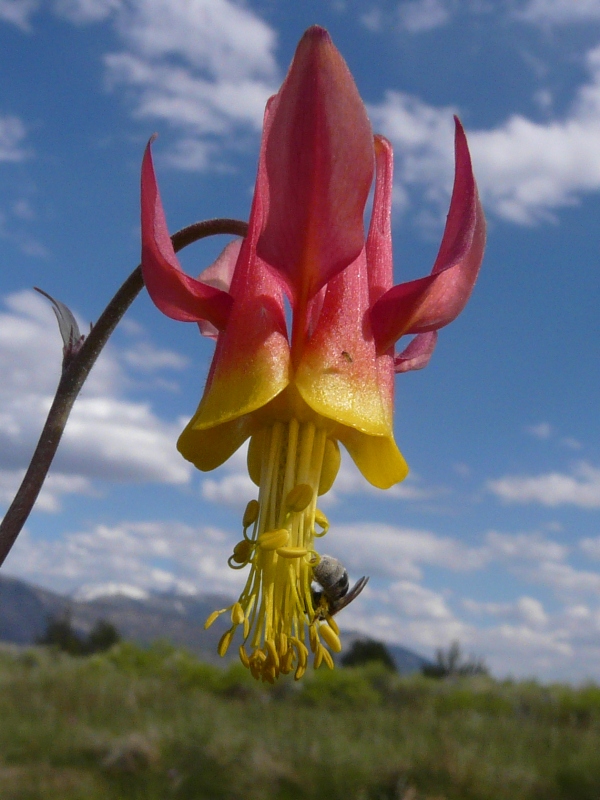
As we moved across the playa wetlands where the Parish Phacelia was growing, we came to an emergent wetland community. Aquilegia formosa was blooming beside some open water. Two photos of the same flower from different angles.


I believe this shooting star is Dodecatheon pulchellum. There were so many of them that they turned the marsh purple/pink.

Thanks for the comments!  This gorgeous little flowers is Sea Milkwort (Lysimachia maritima).

We were excited to find this member of the Hydrophyllacea. I believe this is Hesperochiron pumilus. It was growing in the open part of the wetland.

This Monkeyflower was blooming beside the Columbine in the wetland. I believe this is Mimulus guttatus. As with all of these flowers, feel free to comment with ID corrections.

Friday, July 1, 2011

Great Basin Plants part 2


Here are some of the common plants that we would see in Spring Valley. Of course there is a lot of Sagebrush and Greasewood. Some Saltbrush and Winterfat. But the Spiny Hopsage (Grayia spinosa) sure was attractive this time of year with its red bracts.

T
here is quite the diversity of Astragalus species out in the Great Basin. This one was fairly common and widely distributed throughout the area. It was fun to look at the different patterns on the pods. Some where all red, some green, and many in between.


One of the more common native grasses was Elymus elymoides, or Squirreltail. The scientific name always made me wonder. Of course it is an 'elymus-like elymus'.


This Eriogonum (ovalifolium) was one of the more common ones in the valley. It was very short, but the flowering heads were very showy. A rough count of Eriogonum species (Polygonaceae) in Nevada totals 82 species.


This was one of the highly-invasive species in the valley, Halogeton glomeratus or Saltlover. It thrived on disturbance, and would grow along two-tracks and in cattle-trampled areas, forming thick mats. Initially, careful attention had to be paid to tell this from fresh sprouts of Greasewood (Sarcobatus vermiculatus) and from young Tumbleweed (Salsola tragus). Halogeton has a spiny tip to the leaves.