Thursday, April 5, 2012

Buglossoides arvensis

I have been enjoying taking my new Field Manual of Michigan Flora out for a spin recently. Currently, that means spending most of my time with the Brassicaceae key and the Veronica key. I was excited to find a small, white flower that I did not recognize along an old railroad path in central Indiana. Unfortunately, I couldn't get any further that day, failing in my attempt to key to family. The next day, I brought along good old Newcomb and got right to Lithospermum arvense. I went back and started the key for Boraginaceae. I was worried that it was not taking me to Lithospermum, but then I realized that Corn Gromwell has a new name. This is an introduced flower, but I enjoyed the chase. In my experience, the pleasure in successfully making it through a dichotomous key is directly proportional to the frustration experienced when stymied.


Wednesday, April 4, 2012

Sand Phlox, Cleft Phlox

Frequent in the western part of the Kankakee region of northern Indiana (also on dry sandstone further south), Phlox bifida has a special affinity for dry, stable sandy slopes, especially the hottest ones facing south or west.
Countless thousands of these were flowering in Newton County today. Photographed in Black Oak savanna at Indiana's only ghost town (Conrad) in the Conrad Savanna Nature Preserve.
I have lots of pictures of this plant already, but how could I pass up another chance? Photographed April 4th, 2012.

Tuesday, April 3, 2012

Denizens of Dry Country: Birdfoot Violet and Hoary Puccoon

Impressive displays of these two natives are occurring in the dunes region and the Kankakee sand country of northern Indiana. These photos were captured in and near the Ober Savanna Nature Preserve in Starke County. It's one of many excellent properties owned and managed by The Nature Conservancy.
Viola pedata, Birdfoot Violet


Lithospermum canescens, Hoary Puccoon.
This species has very soft hairs on the leaves. "Lithospermum" = stone seed.

Thursday, March 29, 2012

Prehistoric Plants?

A coworker recently brought me two fossils that were collected by an excavator working near Dewart Lake in Kosciusko County, Indiana. 


Any paleobotanists out there that can provide suggestions as to what this is?  Above is a side view, and below is a top view.


Based on comments to a past post on Get Your Botany On!, I think this may be Sigillaria sp., but I would welcome all suggestions.


Above is a photo of the entire fossil; below is a close-up.


This is well beyond the area of my expertise, so any help is appreciated!

Wednesday, March 28, 2012

Spring Beauties!

Common throughout the eastern half of North America, Claytonia virginica is just one of those plants that many of us continue to photograph year after year. For some reason the candy stripes are much darker and more prevalent this year! Photos from Bendix Woods and Sebert Woods in northern Indiana, March 25, 2012.


"Without anxiety let us wander on, admiring whatever beauty the woods exhibit." Henry David Thoreau, 1850.

Sunday, March 25, 2012

Field Guides: Help or Hindrance?

Here is a question I find myself wrestling with on a regular basis; are field guides good for the SCIENCE of botany? The more botanically aware I become as a scientist the more convinced I am that they are very often used by the wrong people and for the wrong task.

Famed bryologist Paul Redfern once said that "keys [floras] are written by people that don't need them for people who can't use them". There is a sad truth to this and it is often the mechanism that turns more and more people to field guides. But is this a good thing?

My understanding of field guides is that they are intended for non-professionals (hikers, wildflower enthusiasts, etc.) but I know many professionals that use them as primary references. I fear that this dumbs-down the profession or at the very least gives non-botanist professional scientists a false sense of what it really takes to know a flora.

Anyway, I figured that GYBO has such a mix of professional and nonprofessional botany/ecology people, that it would make for an interesting conversation. Please share your thoughts.

Thursday, March 22, 2012

Plant Quiz

Does anyone recognize this plant? I don't know what it is, but hopefully some of you can provide a name. It's not aromatic at all, but is it an Artemisia? It grows in vacant lots in South Bend, Indiana and is probably a garden escape, but I don't study cultivated plants. I seem to recall seeing it in flower beds somewhere.

Thanks!

Monday, March 19, 2012

That Sure Must Stink!

At Cornell University, the spathe of Amorphophallus titanum (Titan Arum, aka Corpse Plant) has opened, exposing its spadix of smelly flowers. For more information and a live webcam view, visit http://bhort.bh.cornell.edu/Atitanum/index.html.

Photo from Wikipedia.org

Sunday, March 11, 2012

Snow Trillium!

On Saturday, March 10, Trillium nivale was flowering on a steep, southwest-facing slope in the Kokiwanee Nature Preserve, Wabash County, Indiana. Most plants were just in bud but a few were wide open, with pollen visible on the anthers.

Speckled Alder

Alnus rugosa was flowering profusely today in wet ground along the Norfolk Railroad in Starke County, Indiana. The yellowish catkins bear the staminate (male) flowers, while the small, reddish cones contain the pistillate (female) flowers. Photographed March 11, 2012.

Sharp-Lobed Hepatica

Several plants of Hepatica acutiloba were flowering Saturday on an eroded, southwest-facing slope in the Kokiwanee Nature Preserve, Wabash County, Indiana. Photographed March 10, 2012.

Some are now calling this Hepatica nobilis var. acuta.

Friday, March 9, 2012

Charles Deam Article

On a recent wintry day at the town library, I was walking past the magazine racks and there was our legendary botanist Charles Deam on the cover of "Traces of Indiana and Midwestern History!"

Left to right: Frank Wallace, Indiana Dept. of Conservation Entomologist, Charles Deam, Botanist, and Frank McFarland of the University of Kentucky. Photographed at a conference at Clifty Falls State Park, May 14, 1949. From Indiana University Archives.

The article inside tells his story very nicely and was written by Jennifer Harrison. The issue date is Fall, 2010, and the article includes several pictures of Mr. Deam that I had not seen before. The extraordinary legacy of this man's passion for botany lives on!

(See also: http://getyourbotanyon.blogspot.com/2012/02/traces-of-charles-deam.html

Photo from Ball State University Archives.

Tuesday, March 6, 2012

Erigenia bulbosa, Harbinger of Spring!

Today in a mesic forest dominated by beech and sugar maple, Harbinger-of-Spring was flowering here and there. None of the plants I saw had risked unfurling their leaves yet.
Photographed at Potato Creek State Park in St. Joseph County, Indiana, on March 6, 2012.

Veronica persica, Bird's Eye Speedwell

Sunshine, blue sky, and mild temperatures worked their charm on northern Indiana today, and Bird's Eye Speedwell responded with a few sky-blue corollas. These flowers are quite large as speedwells go, nearly a centimeter in diameter! As the seed capsules develop the peduncles elongate quite noticeably.
Photographed in the horseman's campground of Potato Creek State Park in St. Joseph County, Indiana on March 6, 2012.

Draba verna, Vernal Whitlow Grass

Little Draba verna is a mustard that flowers very early. It tends to cover a lot of sandy and gravelly places, and is also quite frequent in ag fields that have not yet been planted. In the classic "Sand County Almanac," Aldo Leopold called Draba "a small creature that does a small job quickly and well." It is very possible, however, that he was talking about the related Draba reptans, a sand country native.
Photographed in the horseman's campground at Potato Creek State Park, St. Joseph County, Indiana, on March 6, 2012.

Saturday, March 3, 2012

Green in Winter: Plant Quiz Solved! Blephilia hirsuta

Good call Nate! It is Blephilia hirsuta, Wood Mint. This plant is often associated with alluvial soils and slopes in mesic woodland. The leaves have a very appealing aroma when crushed.

Posted previously:
This plant was photographed on a slope above the Eel River in Miami County, Indiana in mid-February, 2012. Can you identify it? Feel free to name the plant or just take a guess!

Tuesday, February 28, 2012

Traces of Charles Deam

One of the most extraordinary people ever to have lived was Charles Clemon Deam, a self-taught botanist from Indiana. His fascinating life story has been told very nicely by Robert Kriebel in a book entitled “Plain Ol’ Charlie Deam, Pioneer Hoosier Botanist.” I won’t repeat it here, but I strongly recommend the book to anyone with an interest in botany and perhaps Indiana history.

Just outside his hometown of Bluffton, Indiana is the “Deam Oak,” a preserved living tree northwest of town. It’s a hybrid of Chinquapin Oak and White Oak (Quercus X deamii) that was discovered by Deam’s good friend E. Bruce Williamson, and named in honor of Deam by William Trelease. This hybrid occurs here and there – the preserved tree at Bluffton is not the only one.

This is the detritus that was under the tree in February, 2012.

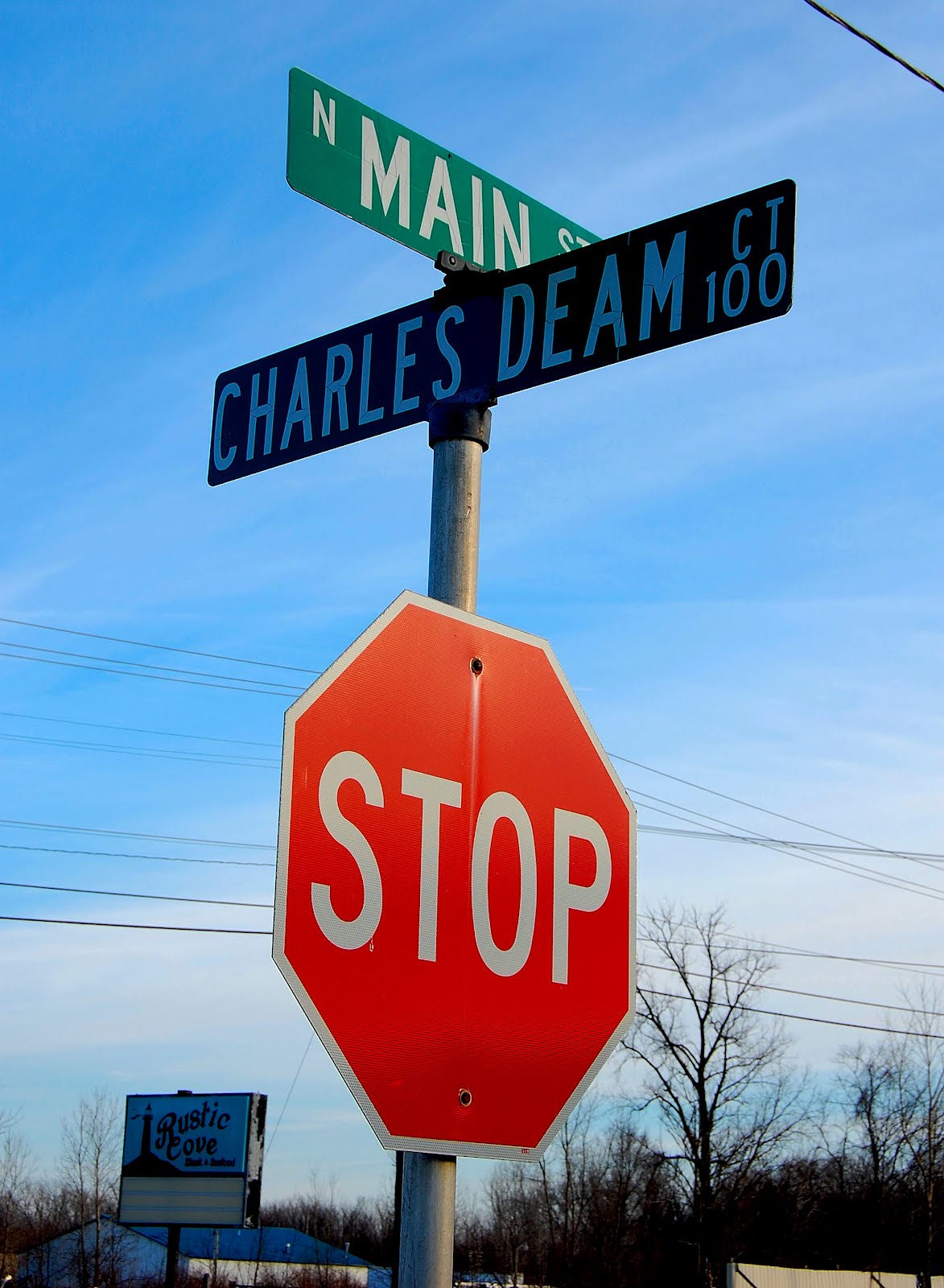
North of the town square in Bluffton there is a street named “Charles Deam Court,” and near his home and arboretum there is a historical marker, tastefully displayed in a very nice town park along the Wabash River. Obviously someone in Bluffton knows about this great man, and for this we should be grateful.


In addition to being a phenomenal botanist, state forester, and manager of his own herbarium and arboretum, Deam was a drugstore owner. His store was located at 103 South Main Street, right next to the Wells County Bank on the corner.


Sadly, renovation has hidden all traces of his store, with the bank on the corner and his drugstore now both included in the Wells-Fargo Bank that occupies most of the block

Deam’s prosperous and productive life spanned nearly a century: he lived from 1865 to 1953. His influence on Indiana botany lives on, and his remarkable legacy includes four of the finest floras ever written (Flora of Indiana, Trees of Indiana, Shrubs of Indiana, and Grasses of Indiana). These are not mere traces of Mr Deam’s life; they are important parts of his very solid legacy, and they continue to provide us with excellent scientific data, gathered by a man who spent his days in natural areas, studying, documenting, and sharing his discoveries and observations.

The legendary Floyd Swink of Chicago once mentioned to someone from the Shirley Heinze Land Trust that he had a file of letters between himself and Mr. Deam, and this correspondence was published by the Heinze Trust in the year 2000. I strongly recommend this book and all others mentioned above.

On a recent visit to my local library (sometime in the fall of 2010), I was walking past the magazine racks and there was Charles Deam on the cover of the "Traces," a magazine published by the Indiana Historical Society. The article inside was very nicely written, and there were a few more pictures of Mr. Deam that I had not seen before.

When I was in college at Ball State in the 1970’s, I met a student from Bluffton and asked if she had heard of Charles Deam. I don’t remember her answer, but it’s remarkable that I had heard of him by the time I was a teenager, and even knew that he was from Bluffton. I grew up far from Bluffton, had never seen his books, wasn’t majoring in a science-related field, and personal computers and the Internet had not been invented yet. Did I hear of him in school? I don’t remember.

At the end of my recent Bluffton visit, I stopped for a sandwich as I was heading out of town. Three young people (maybe mid-20’s) were working, and I asked if they knew who Charles Deam was. One of them replied, “Charles Deam Court?” and I said, no, not the street – the actual person. Sadly, all shook their heads, they had no idea who he was. Alas!

In conclusion, here are a few of my favorite Charlie Deam quotes, in no particular order:

“It is the little things we can do for others that makes life worth while.”

“I do hate a lazy person. A lazy person ordinarily is a liar and a thief, too.”

“I shall never forget my toughest day. I started down a newly graded road (all roads unknown to me at that early date) of 4 miles. In the 4 miles I had to change tires three times. Inner tubes in those days were very poor quality. It was in the fall of the year with a strong wind and drizzling rain. I was from about 9:00 A.M. until dark making the 4 miles and I doubt if a single vehicle passed me that day…. I wanted to get off this road and when I did I drove into a woods and the car scarcely got over the side ditch when I was “in” to the hubs. So I just camped there that night but I did get out my stove and make some coffee to help me get down my bread and peanut butter.”

“…I got well in spite of the M.D’s.”

“…I have spent all my time on something I consider worthwhile. In so doing you meet a lot of opposition.“

“We have too many dishonest and ignorant men in political places.”

“The Lake Michigan area is a critical area but it has been so badly treated the past 75 years that it no longer represents its former self.”

“Old General Debility will give the commands, and believe me, you will obey.”

“I understand they are strongly recommending now that all the old cemeteries be planted with multiflora rose. When Gabriel sounds his horn, I am afraid some will be stranded and not be able to get thru the roses. Please do not recommend the multiflora rose except for the bonfire.”

“Friesner, you collect grasses like a cow.”

“…I did my darnedest, and in it you have my measure.”

“I am just plain ol' Charlie Deam and I never want anyone to think anything else.”

Friday, February 24, 2012

Plant Quiz Solved! Black Locust, Robinia pseudo-acacia

Good call, A.L.! It is Robinia pseudo-acacia, Black Locust. This is an impressive looking tree when it matures, but it is said to have nitrogen-fixing bacteria in root nodules and as a result, it inhibits the growth of many other plants (Google "Allelopathy"). Young trees (and young branches on older trees) have small but very sharp spines. The lower bark on mature trees is VERY deeply furrowed and distinctive (see below). This is why the lower trunk was cropped away from the plant quiz photo!
-----------------------------------------
Can you identify this tree just by its distinctive shape? Good luck! Please feel free to ID the tree or just take a guess. Photographed in St. Joe County, Indiana.

Tuesday, February 21, 2012

Plant Quiz Solved! - Tree Bark - Gleditsia triacanthos

Good call A.L. and Tom! It is Gleditsia triacanthos, Honey Locust. This is the native tree that normally has large, stout, branched spines all over the trunk. This tree had them, but they were up higher on the trunk. In Indiana it grows in forested bottomlands, but is not very common in the northern third of the state. The unarmed cultivar of this tree (var. inermis) is used extensively in landscaping, especially where large leaves would be a problem on sidewalks, etc.
--------------

Can you identify this tree just by the bark? Feel free to name the tree or just take a guess! Photographed in central Indiana.

Monday, February 20, 2012

Cardamine douglassii - Spring Cress

Today in central Indiana I was startled to see Spring Cress with a single open flower right near the basal leaves. Remarkable! Photographed in Wabash County, Indiana on February 20, 2012.