Saturday, August 24, 2013

If There Was A Needle In That Haystack...

In early July, I joined Rich Dunbar and Roger Hedge in a search for one of Indiana's most diminutive and inconspicuous orchids, Malaxis unifolia.  We were at a known site for the species, but it hadn't been seen there in many years, and we didn't have good location or population size information.  For the first few hours of our visit, we searched unsuccessfully, making us begin to wonder if it was no longer present at this site.
 

Then, by some small miracle, I spotted a tiny sterile leaf on a mossy hummock that I was convinced was Malaxis unifolia.  This led us to find several plants in the first of a few populations of Malaxis that we found that day. 


I'd seen this little green-flowered orchid before in Wisconsin, but I had forgotten just how small it was.  The Drosera rotundifolia leaves in the first photograph above give an idea of scale.  Given the size and flower color, how many individuals were there that we didn't find?


Malaxis unifolia is known from the eastern half of North America, but it is most frequent in the upper Great Lakes region and in New England.  It is considered a species of conservation concern in six states.  Habitat includes swamps, bogs, and in much drier conditions in heathlands, sand barrens, and open upland woods.  This is another species that seems to be more reliant on soil chemistry than soil moisture.

Stachys hyssopifolia

I recently was in a sand prairie/savanna remnant in St. Joseph County, Indiana when I stumbled into a healthy population of Stachys hyssopifolia (I later found out that Keith Board had found this population years before).  This mint is found at various locations in states along the east coast of the United States, but it is also disjunct in the Midwest/Great Lakes region, specifically in Michigan, Indiana, Illinois, and to a lesser extent in Missouri.  In 25% of the states in which it occurs, Stachys hyssopifolia is considered a species of conservation concern.
 

Stachys hyssopifolia has an interesting ecological distribution.  Those who have compiled the National Wetland Plant List seem to think of this species as a pure wetland plant, as it is ranked as OBL or FACW in all regions in which it occurs.  That would mean that it is almost always found under wetland conditions but that it is occasionally found in uplands.  Many of the references I checked state that this species is found in moist soils, often near lake margins, and also in bogs.  This is of course true, but it is also found in dry acid soils of prairies and savannas.  Regardless of wetness, it seems that Stachys hyssopifolia tends to require acidic conditions.

 
Stachys hyssopifolia, like some other members of the genus, is said to have edible tubers.
 

Friday, August 16, 2013

That's Why They Call It....

Wild Golden Glow!  This common native, Rudbeckia laciniata, lights up the darkness when it grows in damp, shady places.

Monday, July 22, 2013

Fringed Loosestrife

The nodding flowers of Lysimachia ciliata seem to light up the shaded darkness of wooded floodplains in summer. Note the ciliate leaf petioles.Photographed at Potato Creek State Park in St. Joe County, Indiana. This is a very common native plant.

Sunday, July 21, 2013

Piedmont Bedstraw


The tiny Galium pedemontanum was first discovered in the Chicago Region by the sharp-eyed Ken Dritz, who found it as a lawn weed in both St. Joseph and Starke Counties in Indiana. Good work Ken!

Friday, July 19, 2013

Field Madder


Little Sherardia arvensis is one of many obscure weeds that the inimitable Ken Dritz discovered in the Chicago Region. He also discovered numerous native plants in places where they were not previously known, and we owe him a debt of gratitude for adding so much to our knowledge of wild plants in the Midwest. Thanks Ken! Photographed in a lawn at New Carlisle, Indiana.

Tuesday, July 16, 2013

Tall Bellflower

Campanula americana is a common native that tolerates the deep shade of mesic woods but often shows up along trail edges, forested road edges, and near treefalls where a little sunlight gets in. Common in northern Indiana, it's my guess that it's common all over the state, with a possible exception of the prairie counties in the northwest corner. The flowers are attractive and unusual, and if it was a rare plant we'd go crazy over seeing it. At any rate, it's a native and we should enjoy it when we see it. Photographed in rich woods in rural LaPorte County, Indiana.

Monday, July 15, 2013

Red-berried Elder

Growing in rich, deeply shaded forests, Sambucus pubens is much less common than the related Common Elderberry (S. canadensis). This one was photographed in rural LaPorte County, Indiana. The crushed foliage of this shrub smells pretty bad!

Friday, July 12, 2013

Harebell

Campanula rotundifolia ranges pretty much all over North America, with the exception of the southeastern US. In northern Indiana, it is occasional in sandy Black Oak savannas and frequent on the foredunes of Lake Michigan. The specific epithet "rotundifolia" draws attention to the rounded basal leaves, which, in my experience are more often reniform (kidney shaped). The cauline leaves are linear. This plant can be difficult to photograph because the flowers almost always are dancing around in the breeze on their delicate stems. Photographed on the foredunes of Lake Michigan in Porter County, Indiana on July 11, 2013.

Thursday, July 11, 2013

Spatulate-leaved Sundew (Drosera intermedia)

Occasional on wet sand flats and abundant in sphagnum bogs, sundews are plants that capture insects and eat them! Well, they don't actually chew them up and swallow, but they do absorb nutrients from the bodies of the bugs they trap. The bugs get caught in the sticky liquid on the leaf hairs and the rest is history. In northern Indiana, sundews should begin producing small, white, 5-merous flowers in the next week or so. This video shows a variety of insectiverous plants, with a time-lapse of the closely-related Round-leaved Sundew at 1:10.   https://www.youtube.com/watch?v=KYGwgzehf6c  


Wednesday, July 10, 2013

Swamp Candles

Adding brightness to the low meadow on overcast days, Lysimachia terrestris is occasional in low, sometimes mucky spots in high quality wet meadows. Photographed at Liverpool Sandpits in Lake County, Indiana on July 7, 2013. 


Monday, July 8, 2013

Wild Blueberry

Have you noticed the super abundance of all kinds of fruit this summer, both wild and cultivated? Recall last spring that it just never got warm outside, and it seemed like every weekend was cold and wet. Somewhere at a greenhouse my wife talked with a guy from Arkansas or Alabama and he called it a "raspberry winter." He said that a spring like that would result in more fruit that we knew what to do with and it's starting to look like he was right. We could attribute this to the abundant rain this summer, and while that certainly helps with the size of the fruit, something good had to happen last spring when these plants were flowering.
This Vaccinium was fruiting with more abundance and larger fruit than I had ever seen, at a sandy black oak savanna in Lake County, Indiana. It was a low shrub about knee high, and it is either Vaccinium angustifolium or V. pallidum. Can anyone offer opinions on the I.D? Thanks! I apologize but I didn't notice whether the underside of the leaf was pale or not.   Eat well, breathe easy, and thank a plant for both!

Sunday, June 30, 2013

Early Summer in the Prairie

Late last summer, I visited a site near Lowell in Lake County, Indiana and unexpectedly stumbled into a dry-mesic prairie opening with good diversity and unique species including Asclepias viridiflora, Aster laevis, Ceanothus americanus, Eryngium yuccifolium, Liatris scariosa var. nieuwlandii, and Petalostemum purpureum.  I had a chance to get back to the site a few weeks ago.
 
Dry-mesic Prairie Remnant with an abundance of Silphium terebinthinaceum
In northwest Indiana into Illinois, it is not uncommon to see Silphium terebinthinaceum along roadsides... an indication of the prairie that once was.  In most cases, this is one of the only natives that remains, with Solidago rigida and Ratibida pinnata sometimes holding on as well.  In the case of this site, a rich prairie flora has persisted in this remnant despite lack of intentional management.

Lobelia spicata
One of the plants that I noted in this remnant last summer that was in bloom a few weeks ago was Lobelia spicata; it should continue to flower into late August, but its inflorescences get a bit twisted later in the season.  This is primarily a prairie, savanna, and glade species of eastern North America.  Its flowers look similar to those of Lobelia kalmii, a species of wet, calcareous soils, but the leaves of Lobelia kalmii are less than 3 mm wide, whereas those of Lobelia spicata are more than 3 mm wide.

Parthenium integrifolium was also beginning to bloom when I was at the prairie this summer and should continue to bloom into mid-September.  This composite grows in prairies, savannas, and glades and doesn't tolerate site degradation.  It has been used to make a tea to treat fevers (hence one of its common names, American Feverfew), and was also used to treat malaria.  A similar species, Parthenium hispidum, is known from the central United States.  It has stems with noticable speading hairs, upper leaves that are auriculate-clasping with spreading hairs on the veins beneath, and larger flower heads.  Parthenium integrifolium has stems that are glabrous to minutely pubescent, upper leaves that are sessile but not clasping with mostly appressed hairs on the veins beneath, and smaller flower heads.  Flora of North America treats these both as Parthenium integrifolium, not even warranting varietal status to Parthenium hispidum.  Having seen both, this surprises me.
 
Parthenium integrifolium
Nearby is a railroad prairie remnant that I also surveyed in 2012.  Interesting prairie plants at this location included Allium cernuum, Comandra umbellata, Dodecatheon meadia, Heuchera richardsonii, Phlox pilosa, Silphium integrifolium, Veronicastrum virginicum, and Zizia aurea.  I also noted the remains of an Oenothera that I was able to verify this summer.

Oenothera fruticosa
Oenothera fruticosa is identified by its winged, glandular pubescent ovaries and its large petals.  It is a showy prairie species with a range including much of eastern North America.  The very similar Oenothera pilosella, which lacks glandular hairs on its pubescent ovaries, is sometimes found growing with this species, and it can be difficult to distinguish between the two.

Prairies reach their full glory late in the season, but there is plenty to see early in the summer as well.

Monday, May 27, 2013

Geum rivale

I had the opportunity on Saturday to botanize several southwest Michigan sites with Brad Slaughter and Dave Cuthrell.  As we were leaving a fen and heading back to our vehicles, Brad spotted the unique Geum rivale (Purple Avens) along the gravel road.
 

Geum rivale is a circumboreal species, being known from much of Canada south into the Upper Great Lakes and the Rocky Mountains, as well as northern parts of Europe and Asia. Because it reaches the southern edge of its range in a few northeastern Indiana counties, it is listed as endagered in the Hoosier State. 
 

We saw some pretty interesting plants on Saturday, including orchid hybrids, state-listed species, and good mesic forest sedges, but this member of the Rosaceae was one of my highlights.


Wednesday, May 22, 2013

Late May in an Indiana Circumneutral Seep

Just a few shots from a rich circumneutral seep in Cass County, Indiana on 22 May 2013...
 
Circumneutral seep
Phlox maculata
Phlox maculata
Ranunculus hispidus var. nitidus
Saxifraga pensylvanica

Friday, May 10, 2013

 Arctostaphylos uva-ursi (bearberry)

A member of the heath family. This low, woody, creeping evergreen plant resides in the Indiana Dunes as a glacial relic. It can be found in many different habitats in the dunes, but has a close association with jack pine which typically is found in the foredunes.

Botanist Michael Huft informs me that the word arctostaphylos means bear-berry in Greek, and that uva-ursi means bear-berry in Latin. It was known as kinnikinnik by Native Americans of the Algonquian Nation, probably Delaware, referring to a mixture of leaves, bark, and other plant materials to form a smoking product.


Tuesday, May 7, 2013

Betula nigra

Today in Marshall County, Indiana, Betula nigra was blooming rather profusely.  I don't believe that I'd ever noticed it in flower before.
 

Above are the erect pistillate catkins.  The white stigmas can be seen protruding from the scales.  The photo below shows several long dangling staminate catkins.


Betula nigra is a tree of swamps and floodplains of the eastern United States.  It is primarily a southern species, but its geographical range stretches north along major river systems.

Thursday, May 2, 2013

Trillium grandiflorum at Bendix Woods

The floor of Bendix Woods is carpeted with large-flowered trillium just now, and the other spring ephemerals are still fresh because of their late flowering.


Sunday, April 21, 2013

Bellwort

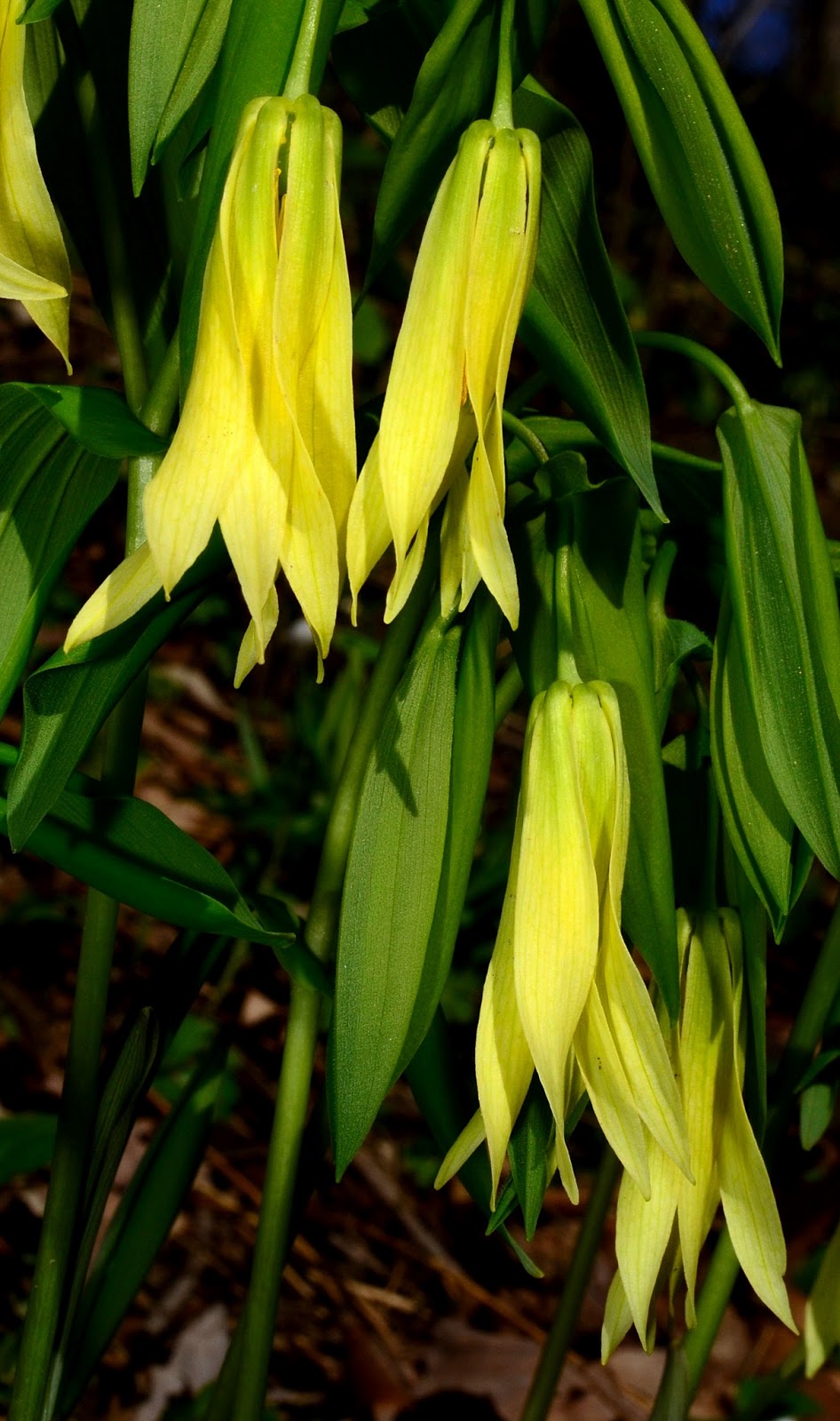
Uvularia grandiflora was flowering abundantly today in central Indiana on wooded slopes facing south and west.


Sessile Trillium

This well known native, Trillium sessile, was flowering in central Indiana today. It is similar to Trillium recurvatum, but Sessile Trillium has leaves that are sessile and sepals that are not recurved.