Showing posts with label Hepatica. Show all posts

Monday, March 28, 2016

Sharp-lobed Hepatica!


Ah spring! Today the sun was shining and the temperature was mild. I took a long walk in the woods and soaked in as much of the beauty as I could carry. I smelled the rich, earthy fragrance of old leaves on the forest floor warming in the sun. The sky was blue, birds were singing, and bees were gathering pollen and nectar. I saw a Mourning Cloak gliding easily on the breeze and a pair of Question Marks racing around in a quick spiral dance. As I sit here this evening, I am savoring the memories of my day in the woods. One of the highlights of the day was a large, spectacular display of Sharp-lobed Hepatica. 


This colorful member of the Buttercup Family (Ranunculaceae) was long known as Hepatica acutiloba. Some are now calling it Hepatica nobilis var. acuta. I am reminded of the words of Gertrude Wister: “The flowers of late winter and early spring occupy places in our hearts well out of proportion to their size.” Well said, and noted!


Saturday, December 1, 2012

Green in Winter: Sharp-lobed Hepatica

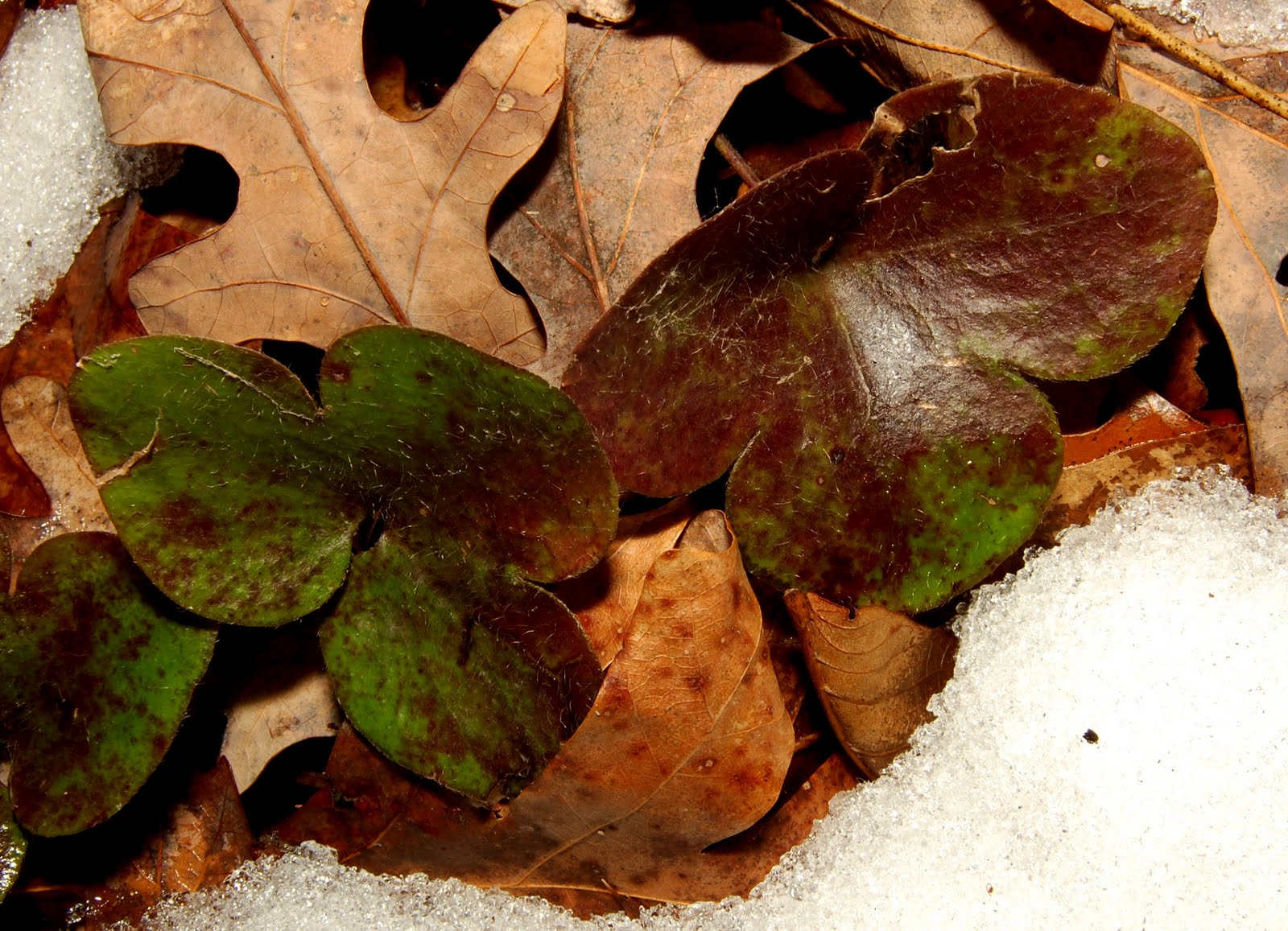
With its distinctive three-lobed leaves mottled with purple, Sharp-lobed Hepatica gives the winter explorer something extraordinary to admire. This plant has a special affinity for steep, wooded slopes on clay soil, but it occurs in a variety of woodlands. Long known as Hepatica acutiloba, it is now called Hepatica nobilis var. acutaPhotographed on December 24, 2011 at Potato Creek State Park near North Liberty, Indiana.


     "We must go out and re-ally ourselves to Nature every day. We must take root, and send out some little fibre at least, even every winter day. I am sensible that I am imbibing health when I open my mouth to the wind." Henry David Thoreau, Journal, December 29, 1856. 

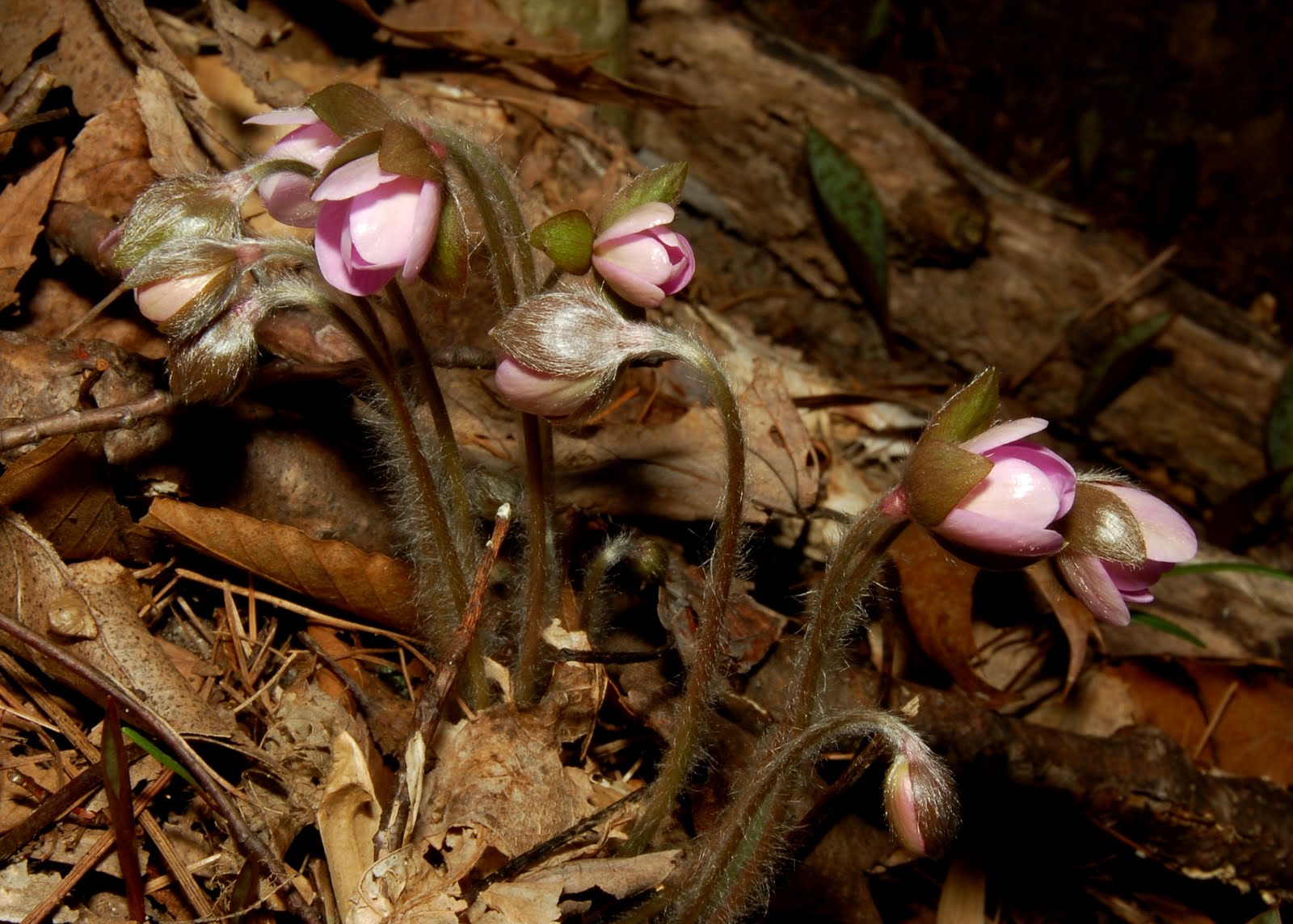
When it flowers in March and April, the plant looks like this. Flower color can range from white to pink to purple, and many shades in between.


Sunday, March 11, 2012

Sharp-Lobed Hepatica

Several plants of Hepatica acutiloba were flowering Saturday on an eroded, southwest-facing slope in the Kokiwanee Nature Preserve, Wabash County, Indiana. Photographed March 10, 2012.

Some are now calling this Hepatica nobilis var. acuta.

Monday, January 16, 2012

Green in Winter: Round-Lobed Hepatica

Hepatica americana is a colorful and attractive member of the Ranunculaceae (Crowfoot or Buttercup Family). It has a special affinity for rotting oak leaves and shaded, acid sandy soil. The dark green leaves have three rounded lobes, often mottled with deep maroon. Flowers open in very early spring and range in color from white through pink to purple. New leaves emerge as flowers fade away. Photographed in the Ardmore section of South Bend, Indiana in January, 2012.


Wednesday, April 6, 2011

Hepatica acutiloba, Sharp-Lobed Hepatica

Early spring on wooded slopes can be delightful when Hepatica starts emerging. In northeast Indiana, it is flowering abundantly on rich slopes in the Edna Spurgeon Nature Preserve. Normally I take a series of pictures using a variety of camera settings. Several examples are included here; the differences between the latter two are subtle. Life is good, and spring is wonderful!


Sunday, April 19, 2009

Good Stuff From Saturday

Unlike most snakes that I encounter while botanizing, this Northern Water Snake did not chase me down and start biting. Its calm demeanor was much appreciated! (maybe it was just too cold). It was sunning itself in Hobart, Indiana on the north edge of Lake George.


Erythronium americanum, Trout Lily,
at Warren Woods State Park, Berrien County, MI.


Hepatica acutiloba, Sharp-Lobed Hepatica at Warren Woods State Park, Berrien County, MI.


Caltha palustris, Cowslip, Marsh Marigold


Indiana Dunes State Park, Porter County, IN.


Chrysosplenium americanum, Golden Saxifrage,


Indiana Dunes State Park, Porter County, IN.
For a student of the flora, it's hard to imagine anything nicer than a 70-degree Saturday in April spent in the woods!

Tuesday, April 14, 2009

Recent Photos - Just For Fun

Ever wonder why you wallow around in natural areas trying to get nice photos of some plant that's just about impossible to photograph? Well it's just who you are, and it's just what you do. At such times I am always, always reminded of these thoughts by Robert James Waller: "Existence takes on meaning only when you give it meaning – by making it meaningful. And how do you make it meaningful? By listening to those almost-secret voices within you that, at certain critical times, whisper, “This is me.” In those moments, it’s important to consciously note what you are doing and do more of it – a lifetime of it, in fact."
Hepatica acutiloba - Sharp-Lobed Hepatica


Dentaria laciniata - Toothwort


Claytonia virginica - Spring Beauty


Cardamine douglassii - Spring Cress


Phlox bifida - Cleft Phlox, Sand Phlox


A little Madness in the Spring
Is wholesome even for the King,
But God be with the Clown
Who ponders this tremendous scene —
This whole Experiment of Green —
As if it were his own!
(Emily Dickinson)

Monday, March 23, 2009

Halcyon Days!

How rare and wonderful when two days of warm, peaceful weather occur on a weekend in March! First, here’s a more cheery look at Erigenia bulbosa to replace the dark and brooding shot I posted earlier.


Veronica hederifolia (=V. hederaefolia), Ivy-Leaved Speedwell, was flowering away on a south-facing slope (degraded lawn), near the edge of the parking lot at an abandoned K-Mart in South Bend, Indiana. I’ve found this plant at 7 sites in northern Indiana and southern Michigan, and it is always growing densely and in profusion far and wide. Though attractive, it seems to have the potential of becoming a troublesome weed in natural areas. The setaceous hairs are so numerous that the colonies take on a grey-green appearance from a distance.


Populus tremuloides, Quaking Aspen, along the Norfolk Railroad in Starke County, Indiana.


Hepatica americana, Round-Lobed Hepatica, flowering abundantly on the summit of a west-facing slope above the Yellow River in Starke County, Indiana.


"Shall not a man have his spring as well as the plants?" Henry David Thoreau, journal, June, 1850.


Friday, March 20, 2009

Scouring the Steep Ozarkian Slopes

Tony Troche, Lindsay, and I were in Missouri last week to spend some time in the herbarium at the Missouri Botanical Garden with Dana and Justin Thomas (and their son Eli). On Friday afternoon, we left the Garden and drove southwest to Salem, Missouri, where we stayed with Justin and Dana for the weekend. On Sunday, Tony, Justin, and I took a botanizing trip to Carman Springs Natural Area. Our target was Claytonia ozarkensis, a plant collected only twice in Missouri, and that has since become extirpated from the state. We knew that it was probably a bit early to find it in flower, but we hoped that since we had seen a few Claytonia virginica in bloom further north, maybe at least the leaves of C. ozarkensis would be visible if the plant was indeed present at Carman Springs. We searched along a creek on the exposed sandstone layers that were sandwiched between dolomite, using binoculars when the terrain was not hikable. While we did see some very interesting plants, including the remains of Carex woodii and Parnassia grandiflora and fresh leaves of Selaginella eclipes and Dodecatheon meadia, we did not locate any C. ozarkensis. Maybe next time.

At one point on our hike along the creek, Justin noticed some yellow-green leaves high on a steep face of a bluff. We couldn't resist climbing up this shallow-soil incline to find out to what species these leaves belonged (we eventually found that they were Dodecatheon meadia leaves). On the way up, we came across Hepatica americana (=H. nobilis var. obtusa) in bloom, and we couldn't resist taking photos.


Unfortunately, these photos don't do justice to the incline we were dealing with. This photo of Tony on the slope in an adjacent glade community helps to show the incline, but the area on which the H. americana was growing was even more steep.


In a glade portion of the bluff, we found Verbena canadensis (=Glandularia canadensis) in bloom.

This is just a taste of some of the earliest blooming Ozarkian flora to wet your whistle on this first day of spring.

Wednesday, February 4, 2009

I need a little spring!

I'm not one to complain about the snow. I love the snow. I love the winter. But even I have to say that spring can't come quickly enough this year. Parts of LaPorte County were blanketed with almost 2 feet of snow... last night! It's only early February, but it's hard to believe that spring will be roaring in less than two months. Since I don't think I'll be seeing any live flowering plants anytime soon, I figured I would post some old early spring photos to hopefully brighten our spirits.

Behold, the harbinger of spring - Erigenia bulbosa! This photo was taken on March 19, 2005 at Fall Creek Gorge in Attica, Indiana.

Trillium nivale, aptly named snow trillium, as it can sometimes be seen flowering while snow is still on the ground. This photo was taken on March 19, 2005 at Fall Creek Gorge.

The ubiquitous spring beauty, Claytonia virginica. In the depths of winter, even the most common of plants can bring us joy. This photos was taken on April 1, 2006 at Mammoth Cave in Kentucky.

When there isn't much florally happening on the forest floor in early spring, Hepatica acutiloba is at its best. This photo of sharp-lobed hepatica was taken at Dowagiac Woods in southwest Michigan on April 15, 2006.

Upside-down, they do look like a Dutchman's breeches, don't they? I took this photo of Dicentra cucullaria at Bendix Woods in South Bend, Indiana on April 10, 2005.

If you've seen the roots of Dicentra canadensis, you understand why it's commonly referred to as squirrel corn. This photo was taken on April 17, 2005 at Bendix Woods.
In mid-April, marsh marigold lights up forested wetlands and seeps. This photo of Caltha palustris was taken in LaPorte County, Indiana on April 19, 2006.
Bloodroot, Sanguinaria canadensis, is beautiful even prior to anthesis. This photo was taken at Waldhaus in Buchanan, Michigan on March 25, 2007.

This perennial favorite, yellow trout lily (Erythronium americanum), is about as photogenic as they come. I snapped this shot on April 10, 2005 at Bendix Woods.
And a final sign of spring, the leaves of Asarum canadense, wild ginger, just beginning to unfurl. I took this photo at the Heron Rookery in Porter County, Indiana on April 1, 2007.

I can't wait for spring!