Showing posts with label Dryopteris. Show all posts

Wednesday, January 9, 2013

Green in Winter: Florist's Fern

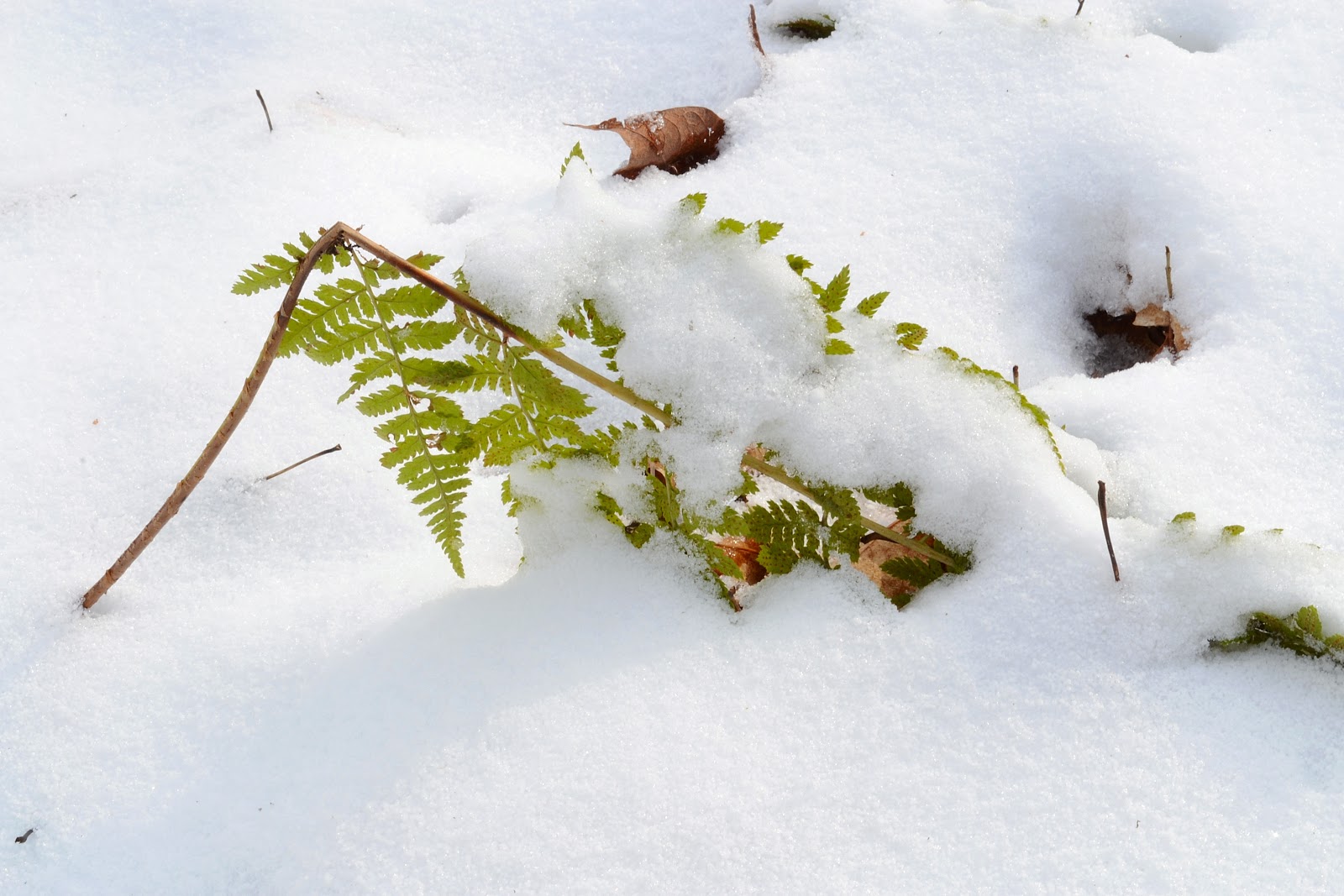
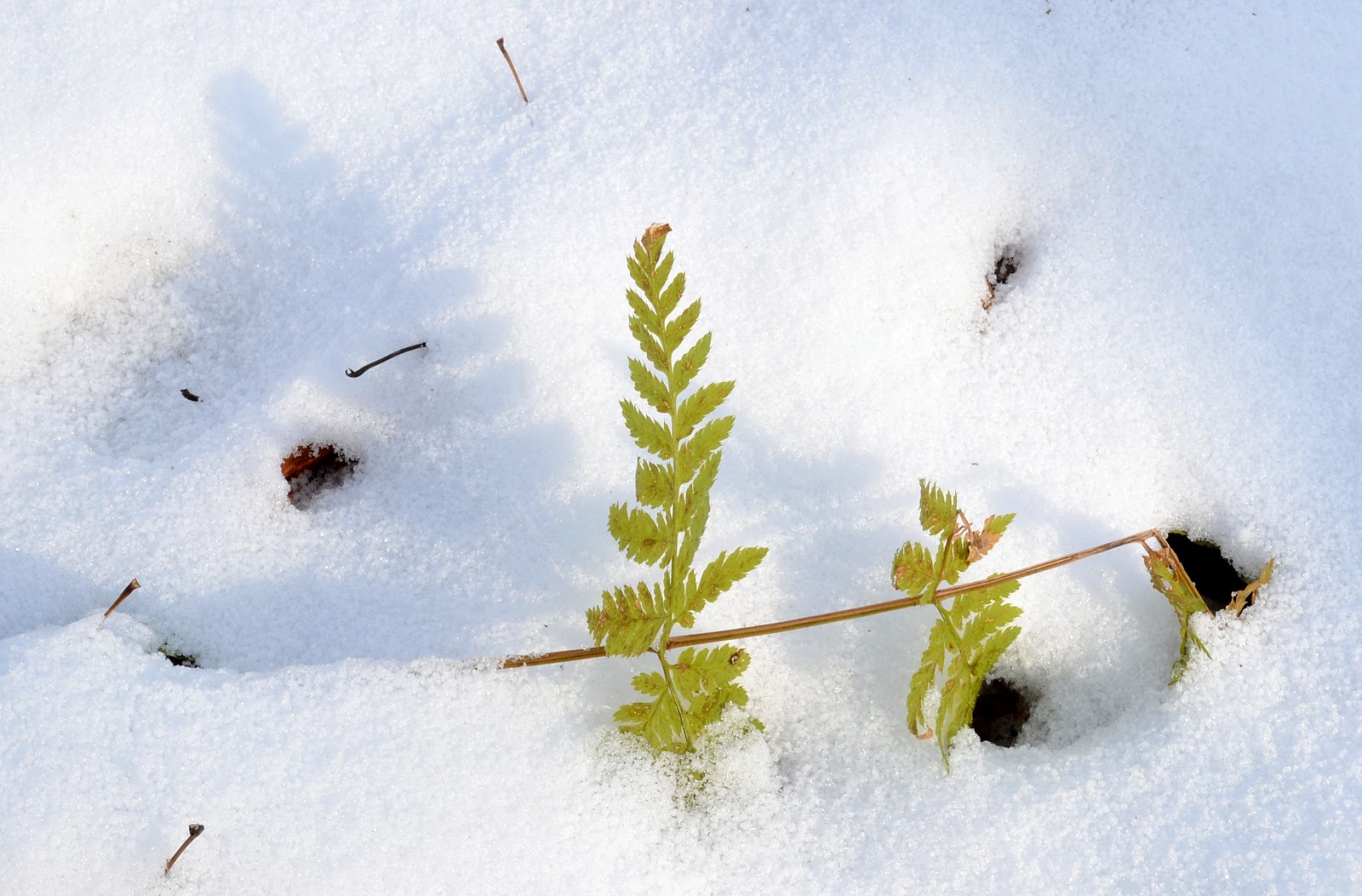
Dryopteris intermedia grows in quality mesic forests. It is similar to Spinulose Wood Fern, but Florist's Fern has the innermost pinnule on the lowermost pinna shorter than to equaling the pinnule next to it. This fern is no longer used in the florist's trade. Photographed at Warren Woods in Berrien County, Michigan, on January 4, 2013.


Wednesday, December 26, 2012

Green in Winter: Spinulose Wood Fern

Dryopteris spinulosa is common in northern Indiana woodlands. It sometimes grows at the base of a tree where water is funneled down along the bark. It is now being called D. carthusiana.


Monday, January 30, 2012

Green in Winter: Marginal Fern

Dryopteris marginalis is a frequent native in the eastern half of North America. Especially common and abundant in the Appalachians, it is one of the most characteristic plants of steep, cool slopes and shaded rock cliffs.

Photographed in LaPorte County, Indiana on January 29, 2012.

It is very well expressed at Turkey Run and Shades State Parks in west-central Indiana, as well as several nature preserves in the vicinity. It is virtually absent from the northern third of the state, with one known exception being a robust population in LaPorte County, on a steep sandy slope above Trail Creek. It occurs at a few sites just to the north in Berrien County, Michigan.

The sori (clusters of tiny sporangia, where spores are produced) occur along the margins of the pinnules (smallest blade divisions), hence the specific epithet marginalis.

Ferns are lovely. Ferns are beautiful. Emma Bickham Pitcher

Nature made ferns for pure leaves, to show what she could do in that line. Henry David Thoreau

Saturday, January 7, 2012

Green in Winter: Goldie's Fern

Yesterday I posted this as a plant quiz: "Photographed in a beech-maple forest in St. Joe County, Indiana on January 7, 2012. Can you identify it?"

Legendary photographer Pete Grube identified it correctly as Goldie's Fern, Dryopteris goldiana. This is a rare one of high quality forests and deep shade, and it is rather difficult to find in northern Indiana. It has a subtle zigzag to the rachis and the pinnules are of uneven lengths. In season, the blade is often held at such an angle to the Earth that it is almost horizontal. The two lowermost pinnae are usually directed back or downward at an angle, giving the blade a sagittate gestalt.

Good work Pete!!

Monday, April 11, 2011

Dryopteris marginalis

Many interesting ferns can be found growing on rocky outcrops, but one of my favorite common ferns has to be Dryopteris marginalis (Marginal Shield Fern).


Found flowing over the edges of sandstone outcrops and ledges as well as growing in the sandy soils of the dunes around the Great Lakes, Dryopteris marginalis is easily identified by the marginally-disposed sori, shown above. This fern is found throughout the eastern half of North America and Greenland, and is apparently also known from Brittish Columbia. I most recently saw this species on the north-facing sandstone ledges at Fall Creek Gorge in Warren County, Indiana. For more plant photos from my recent trip to Fall Creek Gorge, visit my post at Through Handlens and Binoculars.

Friday, February 5, 2010

Numerous Plant Quizzes - Annotated Photo

I recently posted the following photograph from Round Lake in Starke County, Indiana as a plant quiz and asked for identification of as many species as possible.


I've labeled the plants that I was able to ID from the photo and my memory of the site. You'll probably need to click on the photo to expand it to see the answers and the plants they are denoting. The key to the answers is below...

A – Solidago graminifolia v. nuttallii (Euthamia graminifolia)
B – Scirpus pungens (Schoenoplectus pungens)
C – Pycnanthemum virginianum
D – Eupatorium maculatum (Eupatoriadelphus maculatus)
E – Potentilla fruticosa (Dasiphora fruticosa)
F – Lysimachia quadriflora
G – Dryopteris thelypteris v. pubescens (Thelypteris palustris v. pubescens)
H – Rosa palustris?
I – Juncus dudleyi
J – Calamagrostis canadensis?
K – Eupatorium perfoliatum
L – Aster novae-angliae
M – Solidago riddellii (Oligoneuron riddellii)
N – Carex sterilis
O – Typha sp.

I don't see Onoclea sensibilis, Carex brunnescens (maybe this was guessed for Carex sterilis?), or Rudbeckia hirta (maybe this was guessed for the yellow composite in the background, which I think may be a Helianthus?), which were all suggested.

Pretty sharp group we have here! There were very few plants that I was able to identify from the photo and my memory of the site that were not identified by the group. Thanks for all of your comments.

Saturday, January 2, 2010

Lake Michigan Transmogrified

This is what Lake Michigan looks like when cold air picks it up and drops it on evergreens (if you don’t live near the U.S. Great Lakes, Google “lake effect”). It’s always fun to wake up to the beauty of new snow flocking everything. Here are some of the evergreens in my yard.
Canadian Hemlock (Tsuga canadensis)
Austrian Pine (Pinus nigra) with the interesting results of Yellow-Bellied Sapsucker visits

Douglas Fir (Pseudotsuga menziesii)

Balsam Fir (Abies balsamea)

White Spruce (Picea glauca)

Blue Spruce (Picea pungens)

Norway Spruce (Picea abies)

Arbor Vitae (Thuja occidentalis)

White Pine (Pinus strobus)

Holly (Ilex sp.)

Christmas Fern (Polystichum acrostichoides)

Marginal Fern (Dryopteris marginalis)
Amazingly, these trees were purchased as seedlings for about one dollar apiece from the St. Joseph County Soil and Water Conservation District in northern Indiana.
“Let a slight snow come over the earth, and the tracks of men
will show how little the woods and fields are frequented.”
Henry David Thoreau Journal, February 3, 1857.

Wednesday, December 2, 2009

Interesting Little Forest

Does this young forest look mundane? Uninteresting?
It’s quite the opposite!
At a fraction of an acre, it occupies a little corner in a long-abandoned ag field in St. Joe County, Indiana – out of cultivation for at least 30 years. Most of the surrounding land is yellow clay at the surface, and forests in the vicinity are Beech-Sugar Maple. But this little corner is dominated by Red Maple, with occasional Black Cherry and Sassafras on a sandy substrate. Unlike other Red Maple forests, this one is not in a low lying flat, but upland. The sand is almost certainly underlain with clay, keeping moisture at the surface for long periods of time.

When Red Maple forests aren’t too shady the herbaceous vegetation can be pretty exciting, especially if you like ferns, club mosses, and sedges. I first botanized this site in 1997 and found hundreds of Daisyleaf Grape Ferns (Botrychium matricariaefolium).

In 2008 I was startled to find Downy Rattlesnake Plantain (Goodyera pubescens) and Spotted Wintergreen (Chimaphila maculata).

Downy Rattlesnake Plantain Orchid (Goodyera pubescens)

Spotted Wintergreen (Chimaphila maculata)

Last week I went there to photograph Botrychium dissectum and its segregates and was fortunate to see a tiny Spiranthes orchid in seed. Its identification is guesswork, but diminutive Spiranthes ovalis is a possibility.


On the same visit I saw the lovely Shining Club Moss (Lycopodium lucidulum)!
Interestingly, the club moss was growing right at the base of a tree where water gets funneled when it rains. If you’ve never observed this, it’s worth donning a rain suit and going into the forest while it’s raining. All of the water that doesn’t drip from a tree’s limbs or get absorbed by the bark gets funneled right down the trunk, and even during moderate rain, water comes gushing down. Some plants take advantage of this. For example, Spinulose Wood Fern (Dryopteris spinulosa) will grow anywhere in mesic and wet forests, but in dryer sites it survives at the base of tree trunks. Watch for this – it’s a common sight, at least in northern Indiana. Dryopteris intermedia does this too, as shown in this photo from Warren Woods in Michigan. We should keep this in mind when doing native landscaping. And we should never pass up a chance to botanize a Red Maple forest!
Florist's Fern (Dryopteris intermedia)