Gymnocladus dioica is one of the few trees in Indiana with bipinnately compound or "bipinnate" leaves. Is it the only one? I don't know. Also known as "Coffee Nut," it is uncommon in the northwest third of the state, sometimes being found in the alluvium along streams in woods. It also occurs in more upland mesic forest and even on dry fencerows.
Wednesday, June 27, 2012
Kentucky Coffee Tree
Tuesday, June 26, 2012
Blue Beech
The unusual inflorescence of Carpinus caroliniana offers a serious challenge to one of our most recognized birds. The Cardinal sometimes can be seen doing all kinds of contortions to get at the seeds while hanging upside-down from a nearby branch. The dense wood and unusual, sinuous form of the trunk have elicited other common names including Musclewood, Ironwood, and Hornbeam.
Photographed in seed on June 26, 2012 in Marshall County, Indiana.
Monday, June 18, 2012
Stipes on Display?
Friday, June 8, 2012
New England Aster!
I was stunned to see this common fall flower in a state of FGB (full, glorious bloom) today, June 8th (!) on a roadside in Marshall County, Indiana. I noticed a lot of closed flowers, and I have to wonder if any of them were open during the month of May!! I don't have records but I believe Aster novae-angliae normally begins flowering in August or September.
Prickly Pear Cactus
Opuntia humifusa has to be one of the most unusual plants in Indiana, and it is surprisingly widespread in the state. The actual leaves are very small and pointed, falling off early and leaving little bunches of needles. The "pads" are the stems, and the "pears" are the floral ovaries. I admire any plant that can thrive and flourish in deep, dry sand, especially in a prolonged drought. Photographed in Porter and Lake Counties in Indiana.
Sunday, June 3, 2012
Butter-and-eggs, Linaria vulgaris
This showy little snapdragon is one of several attractive non-natives that seem to prefer growing along railroads. Others include Railroad Vine (Convolvulus arvensis), Little Barley (Hordeum pusillum), Viper's Bugloss (Echium vulgare), and Carolina Cranesbill (Geranium carolinianum), just to name a few of the many. Photographed along the C & O Railroad near New Buffalo, Michigan.
Cannabis?
Sunday, May 13, 2012
Ranunculus bulbosus, Bulbous Buttercup
Three cheers for DenPro! On March 22 I posted this photo of a vegetative plant I didn't recognize, hoping someone would be able to name it. To me it looked like Artemisia, and there were a lot of suggestions in different families and genera. DenPro suggested some kind of Ranunculus, and today I discovered he was right!
Finding something new is always fun, even if it's a weed. For the rest of the day's botanizing trip I was champing at the bit to get home to my books and microscope!
"Weeds are flowers too, once you get to know them." Eeyore
Saturday, May 12, 2012
Plant Quiz - Answered!
I recently posted the following plant quiz...
----------
The photograph below was taken in St. Joseph County, Indiana. This should be an easy one, given that pretty much the entire plant is present in the photo...
Good luck!
----------
It doesn't take long for an answer to a plant quiz on Get Your Botany On!, and this time EMP correctly answered with Ellisia nyctelea. This member of the Hydrophyllaceae (waterleaf family) is an annual that grows in mesic forests as well as in disturbed areas where little competition from other species is present. In Indiana, Aunt Lucy, as it is known, was previously documented from a few western counties. I was shocked when I saw it in a forest in St. Joseph County along the St. Joseph River. Luckily, Keith Board was home that Saturday afternoon when I called him from the field, and he was able to look up its known distribution so that I knew to collect it as a new county record.
Congratulation on correctly answering the quiz, EMP!
----------
The photograph below was taken in St. Joseph County, Indiana. This should be an easy one, given that pretty much the entire plant is present in the photo...
Good luck!
----------
It doesn't take long for an answer to a plant quiz on Get Your Botany On!, and this time EMP correctly answered with Ellisia nyctelea. This member of the Hydrophyllaceae (waterleaf family) is an annual that grows in mesic forests as well as in disturbed areas where little competition from other species is present. In Indiana, Aunt Lucy, as it is known, was previously documented from a few western counties. I was shocked when I saw it in a forest in St. Joseph County along the St. Joseph River. Luckily, Keith Board was home that Saturday afternoon when I called him from the field, and he was able to look up its known distribution so that I knew to collect it as a new county record.
Congratulation on correctly answering the quiz, EMP!
Sunday, May 6, 2012
Plant Quiz Solved - Large-flowered Valerian!
Good Call, A.L. and M.Y.O.Q. It is Valeriana pauciflora. It is interesting to note that “pauciflora” means few-flowered, but the common name is Large-flowered Valerian. This native plant has a limited distribution in North America, but can be locally abundant where it occurs. Maps on the USDA Plants database seem to show that Indiana has more known locations than other states in the plant’s limited range. These were abundant in low, rich woods along the Salamonie River in the Kokiwanee Nature Preserve, Wabash County, Indiana.
Do you recognize this plant? Without seeing leaves, identification is much more challenging. Feel free to name it or just take a guess! It was growing in shaded, wet woods.
Fire Pink
Silene virginica is one of those striking plants that just has to be noticed in shady forests in late spring. I saw it again today and tried to improve on the many pictures I already have of this showy plant. I posted a few pictures a week ago but I believe these are better.
Starry False Solomon's Seal
Wood Sedge or Woods Edge?
Whatever it is, I would love to have that in my street address. I'd call it Wood Sedge Road, and I'd get return address labels with line drawings of Laxiflorean sedges!
Sunday, April 29, 2012
Wild Hyacinth
Common in forests and dry, open prairie remnants, the showy Camassia scilloides can be extremely abundant where it grows. Photographed in bottomland woods near the Salamonie River in Wabash County, Indiana at the Kokiwanee Nature Preserve.
Fire Pink
Silene virginica puts on a brilliant show in forests just as the spring ephemerals begin to fade. Photographed near the Salamonie River at Kokiwanee Nature Preserve, Wabash County, Indiana. This is one of many excellent natural areas that have been saved by the Acres Land Trust of northeast Indiana.
Leonard's Skullcap
The diminutive Scutellaria parvula var. leonardii grows in sunny, dry, gravelly sites with very little competition. I had never seen this tiny plant until last weekend when Scott Namestnik and I found it in central Indiana on a gravelly slope. It is now recognized as Scutellaria parvula var. missouriensis.
Friday, April 27, 2012
Western Wallflower
Last weekend I was privileged to botanize with Scott Namestnik, one of the most observant and knowledgeable botanists ever to wield a handlens. I have never learned so many new plants (and bird songs) in one day! We found the exceedingly rare Erysimum capitatum (E. arkansanum) in dry soil in central Indiana. Due to its extreme rarity, we decided not to disclose the location.
"The more I learn, the less I think I know." Helen Keller
Sunday, April 22, 2012
Draba reptans
This year's March warmth hurried the flowering of many of our spring-blooming forest species, but it also affected some of our early species of open habitats, including the (apparently) very rare Draba reptans, or common whitlow-grass. Draba reptans is a tiny annual mustard of open sandy or gravelly soil, including remnant oak savanna and hillside prairies. These specimens were photographed on an open, historically grazed gravelly ridge in Washtenaw County, where plants occurred in gravelly, loose soils and in sandy pockets between tufts of native prairie grasses. This site, discovered in March, is only the second confirmed record since 1935, the last discovered record dating to the mid-1980s.
This delicate annual features fruits that are nearly uniformly wide from the base to apex. I used no coin for perspective, but the petals average only 3-4 mm long, and the hairy basal rosette is approximately the size of a dime. The small, inconspicuous nature of this species, its early bloom time, and its often unremarkable habitat conspire to hide its presence from the botanical community, and it appears likely there are more populations in Michigan waiting to be discovered. Exploration of sandy, gravelly kames, eskers, and moraines in southern Michigan is warranted, particularly areas that feature red-cedar (Juniperus virginiana), common juniper (J. communis), and prairie grasses.
This wide-ranging species is apparently secure in most of its range, but the species is generally rare in the eastern portion of its range, and is considered possibly extirpated in Massachusetts, Rhode Island, New Jersey, Pennsylvania, and North Carolina. Approximately 12 populations have been documented in Michigan (Michigan Natural Features Inventory data).
This delicate annual features fruits that are nearly uniformly wide from the base to apex. I used no coin for perspective, but the petals average only 3-4 mm long, and the hairy basal rosette is approximately the size of a dime. The small, inconspicuous nature of this species, its early bloom time, and its often unremarkable habitat conspire to hide its presence from the botanical community, and it appears likely there are more populations in Michigan waiting to be discovered. Exploration of sandy, gravelly kames, eskers, and moraines in southern Michigan is warranted, particularly areas that feature red-cedar (Juniperus virginiana), common juniper (J. communis), and prairie grasses.
This wide-ranging species is apparently secure in most of its range, but the species is generally rare in the eastern portion of its range, and is considered possibly extirpated in Massachusetts, Rhode Island, New Jersey, Pennsylvania, and North Carolina. Approximately 12 populations have been documented in Michigan (Michigan Natural Features Inventory data).
Saturday, April 21, 2012
Plant Quiz Solved - Thlaspi perfoliatum!
Good call Scott! It is Thlaspi perfoliatum, Small Pennycress, with auriculate-clasping (not perfoliate) leaves on the stem. Some are now calling this Microthlaspi perfoliatum.
Do you recognize this little weed? Feel free to identify it or just take a guess! Photographed in St. Joseph County, Indiana on April 19, 2012.
Wednesday, April 18, 2012
Plant Quiz Solved - German Knotgrass!
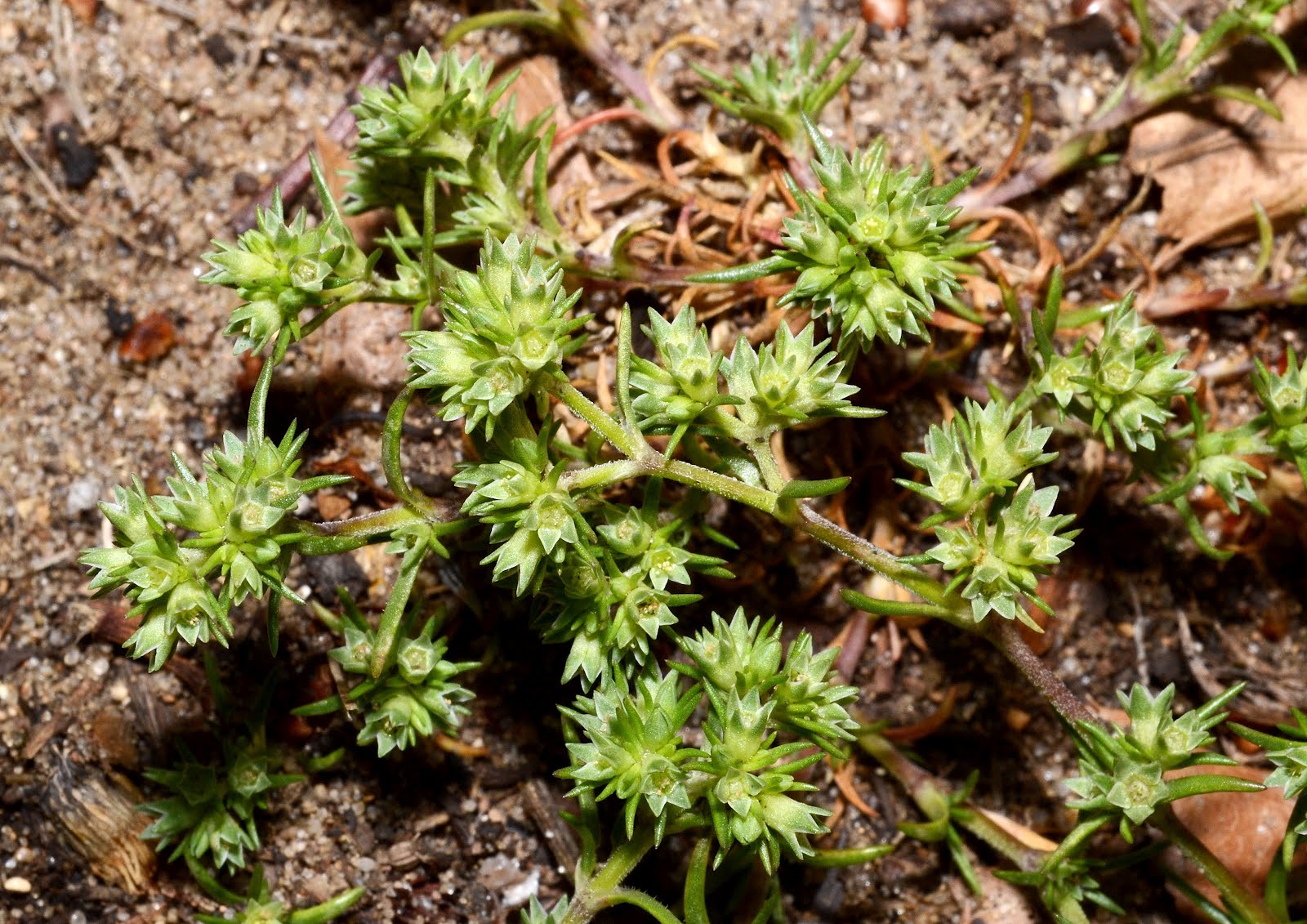
Good call Johnny Hank, it is Scleranthus annuus, German Knotgrass or "Knawel." This small and easily overlooked plant grows all over North America in dry sand and gravelly places. It is not native here. The flowers are green and "apetalous" (without petals), and it's a member of the Caryophyllaceae (Pink Family). Just as the common name says, it is "not grass."
Can you name this plant? Feel free to name it or just take a guess. Good luck!
Subscribe to:
Posts (Atom)