Sunday, October 26, 2008

Lycopodiums

Lycopodium obscurum (Ground Pine, Princess Pine)
Lycopodium complanatum v. flabelliforme (Trailing Ground Pine)

Lycopodium clavatum (Running Ground Pine)


Lycopodium tristachyum (Ground Cedar)


Lycopodium lucidulum (Shining Club Moss)

It was a spectacular day in Sebert Woods! Blustery winds brought down all manner of brightly colored leaves (as well as large limbs) and it was marvelously mosquito-free! I was reminded of Margeret Micklethwait’s line: “Sometimes a rough wind surges through the trees, making a sound like wild and stormy seas, and rushing waves…” Photos from the day include Lycopodium obscurum, L. complanatum flabelliforme, L. clavatum, L. tristachyum, and L. lucidulum. Some of these club mosses are now being called by outlandishly different names, and I’ll hop on that bandwagon eventually. In the meantime, if anyone is splitting the Lycopodium obscurum/dendroideum/hickeyi complex, please feel free to comment. What a pleasant autumn day!

Sunday, October 19, 2008

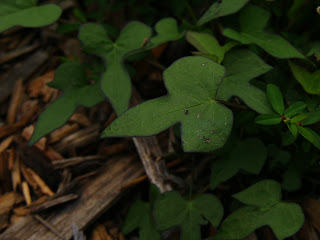
Sassafras albidum

"The odoriferous sassafras, with its delicate green stem, its three-lobed leaf, tempting the travelers to bruise it, it sheds so rare a perfume on him, equal to all the spices of the East. Then its rare-tasting root bark, like nothing else, which I used to dig. The first navigators freighted their ships with it and deemed it worth its weight in gold." Henry David Thoreau, journal entry, August 31, 1850.

Monday, October 13, 2008

Cool Bugs!

Walking Stick on Sassafras albidum and Nursery Web Spider on Pyrola rotundifolia at Wintergreen Woods Nature Preserve in Laporte County, Indiana, earlier this year.


Friday, October 10, 2008

Unusual Trees

The silver maple (Acer saccharinum) reaches out over South Olive Street in South Bend, Indiana. The oak (Quercus sp.) was on a county road south of South Bend. I believe it's gone now.

Monday, October 6, 2008

Botany Slide Show Update

Botany Slide Show is scheduled for November 8, 2008. That's just over 1 month away! Please feel free to show up anytime after noon. The slides will likely begin around 5 PM, but we want to have time to discuss botany, conservation, recent publications, specific sites, etc. before we become immersed in slides. Lindsay will be making antelope chili (antelope courtesy of "Shotgun" Thomas). At this point, I have the following people signed up:

Karen (slides), Paul, and Catherine
Andrew (no slides)
Scott (slides) and Lindsay
Justin (slides and quiz) and Dana (slides)
Bruce (slides)
goooooood girl (slides)
Vic and Marge (no slides)
Bryn (maybe slides), John, and Rilo
Keith (slides)
fish n' chips95 (no slides)
Tony (maybe slides)
Brad (slides)
Nicole (no slides)
Stu (no slides)
Tyler (no slides)

Also, the following people requested shirts:

Karen (L)
Andrew (L)
Scott (XL)
Lindsay (S)
Justin (XL)
Dana (L)
Bruce (L)
Bryn (XL)
Keith (XL)
Tony (XL)
Brad (L)

If you're coming and haven't let me know, please let me know as soon as you can. Also, if you wanted a shirt but you're not listed here, let me know.

I look forward to seeing all of you November 8.

Bonus Plant Quiz

Sunday, September 28, 2008

Regional Variation in C-value. Why?

The Rotala ramosior post of a few days ago got me thinking. Scott mentioned that it has a C-value of 10 in the Chicago region. In Missouri, it has a C-value of 4. In Indiana it has a C-value of 2. Swink and Wilhelm say, as reiterated by Scott, that it occurs in ditches and areas of recent excavation. Unless ditches and recently excavated sites are pristine, pre-settlement natural community types, I don't see how it could possibly be a 10. Even Running Buffalo Clover, a disturbance dependant species, has a C-value of 3 in Indiana.

Because of this regional bias, I am increasingly convinced that C-values should not be regionally specific. In my opinion, a species’ behavior, as expressed by its fidelity to undisturbed habitat, does not vary from region to region. Rotala ramosior is as weedy in Missouri as it is in the Chicago region and Indiana. Therefore it should have the same C-value regardless of region. Am I missing something? Can anyone give me a reason to believe otherwise?

Latest Plant Quiz

Here is the next quiz. Let's hope fish n' chips95 doesn't get it first.

Saturday, September 27, 2008

Hamamelidaceae

Fall is here. Today, in LaPorte County, Indiana, I saw Hamamelis virginiana (Hamamelidaceae) in bloom. Below is a photo.


I can't imagine anyone has claimed the Hamamelidaceae yet, so I'll claim it.

Friday, September 26, 2008

Plant Quiz Answer - Rotala ramosior (these quizzes are just too easy)

It's nice to know that Justin is safe and sound... I hadn't heard anything from him lately, and was beginning to wonder if "goooooood girl" had gotten ahold of him (see the post on Gentiana saponaria if you're lost).


Rotala ramosior has a C-value of 10 in the Chicago Region, and is a plant of Special Concern in Michigan. It is found most commonly in wet, sandy soils with little competition, often around ponds, in ditches, and where excavation has taken place. It therefore can be considered an early successional species that requires some form of disturbance. This plant was photographed several years ago in Southwest Michigan, growing around an excavated pond with Hemicarpha micrantha (Special Concern in Michigan) and Gratiola virginiana (Threatened in Michigan).

Nice work, Justin. Looking forward to your next quiz.

Your Next Plant Quiz

I'm running out of photos to use for quizzes! Here's the next one... it's an old photo, so the quality isn't great.

Wednesday, September 24, 2008

Cleistogamy - Another Try!


Here's a second try at posting the cleistogamous flowers picture, since the other won't expand when selected.

Polygala polygama v. obtusata it is!


Great work, Scott! Racemed Milkwort is one of those admirable denizens of the dry country, showing up in places that are very hot and well-drained.

Polygala = much milk, a reference to the milky sap. Polygama = many marriages, a reference to the many flowers, some of which are cleistogamous and attached to the roots, or on short racemes (above ground) at the base of the plant. Several species of Polygala smell like wintergreen near the base and among the roots. The plant in the second picture was re-planted (and even watered) after the picture was made.

Photographed July 2, 2008 in a Black Oak savannah in Porter County, Indiana. The next plant quiz is yours, Scott.

Sunday, September 21, 2008

Friday, September 19, 2008

Plant Quiz Answer - Gentiana saponaria

You've got it, Keith! Nice work. The quiz photo was of Gentiana saponaria.


This species of gentian is found in sandy moist prairies and in black oak savannas in the Chicago Region. The photos of this plant were taken in September 2007 in a savanna in NW Indiana.

Keith, the next quiz is yours...

Tuesday, September 16, 2008

Time for a New Plant Quiz!

Good luck!

Amaranthaceae - Amaranthus tuberculatus

I'm not sure that anyone is still playing the family game, except for me. In fact, I don't even know if our scorekeepers are still keeping score! Nonetheless, I'm claiming the fantastic Amaranthaceae with Amaranthus tuberculatus (aka Acnida altissima).


Amaranthus tuberculatus is one of the dioecious members of this family. In the photo above, you can see the staminate flowers. I collected both a staminate plant and a pistillate plant to accurately identify this common species.


Amaranthus tuberculatus is found in muddy ground and ditches throughout much of the United States. This plant was photographed in Moline, Illinois on September 11, 2008.

Thursday, September 11, 2008

Plant Quiz Answer: Galeopsis tetrahit

No one correctly guessed the most recent plant quiz, Galeopsis tetrahit, common hemp nettle. Below are photos of the plant in flower.


The genus name Galeopsis means "looks like a weasel," which is supposedly a reference to the flowers. I don't see it. This plant was found in Superior, Wisconsin, but as I said earlier, it is non-native and found throughout much of northern North America.


Since no one got this quiz correct, do I post the next one?