Tuesday, February 21, 2012

Plant Quiz Solved! - Tree Bark - Gleditsia triacanthos

Good call A.L. and Tom! It is Gleditsia triacanthos, Honey Locust. This is the native tree that normally has large, stout, branched spines all over the trunk. This tree had them, but they were up higher on the trunk. In Indiana it grows in forested bottomlands, but is not very common in the northern third of the state. The unarmed cultivar of this tree (var. inermis) is used extensively in landscaping, especially where large leaves would be a problem on sidewalks, etc.
--------------

Can you identify this tree just by the bark? Feel free to name the tree or just take a guess! Photographed in central Indiana.

Monday, February 20, 2012

Cardamine douglassii - Spring Cress

Today in central Indiana I was startled to see Spring Cress with a single open flower right near the basal leaves. Remarkable! Photographed in Wabash County, Indiana on February 20, 2012.

Erigenia bulbosa - Harbinger of Spring

Today in central Indiana I saw a few plants of Harbinger-of-Spring in flower on south and west facing slopes. Back in the late 1980's and early 90's we had a few warm winters (but nothing like this year), and I saw this plant flowering before the end of February two or three different years, but never this early. Photographed in Wabash County, Indiana on February 20, 2012.

Symplocarpus foetidus - Skunk Cabbage

Today on a wet talus slope above the Wabash River I saw Skunk Cabbage with spathes opening and tinged purple, and since they were abundant and I wasn't in a preserve, I took the liberty of tearing one open. Fresh pollen flew all over - it was flowering on February 20, 2012!

In a delightful book entitled "Of Woods and Other Things," Emma Pitcher wrote of Skunk Cabbage: Ever since winter solstice, days started lengthening and small changes are occurring in our natural world. Skunk cabbages sent up tightly furled green leaf cones last September. Now that their strange internal furnaces are activated, dark red flower spathes are forcing up through ice and snow. (Air inside the spathe can be as much as fifty degrees warmer than outside air, so great is the heat the root generates).

Sunday, February 19, 2012

Green in Winter: Running Ground Pine

Lycopodium clavatum has an affinity for thinly wooded sandy acid flats in northern LaPorte County in Indiana. It is occasional in Porter and Starke Counties, and has been discovered in a few northeastern counties as well. It sometimes occurs in red maple swamp forests that are not too wet.
Interestingly, Charles Deam excluded it from his Flora of Indiana (1940) because he had not seen it, and while a few others had reported it, no specimen had been preserved. Though rare, this plant was already somewhat frequent when I began botanizing in the 1980's, so it expanded its range in a mere 40 years. Photographed in LaPorte County, Indiana on December 31, 2011.

Wednesday, February 15, 2012

Field Manual of Michigan Flora released


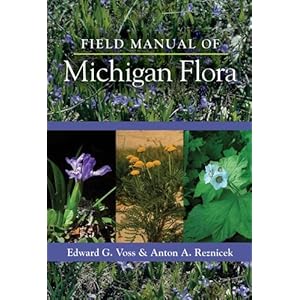
Today, the long-awaited update to Edward G. Voss's classic Michigan Flora, Field Manual of Michigan Flora by E.G. Voss and A.A. Reznicek, arrived via UPS at my door. Gone are the cloth covers, sleeves, color plates, illustrations, and heavy stock, replaced by a sleek-for-its-size, sharply designed work with larger trim that clocks in at just over 1000 pages. Although the emphasis of this work is updated nomenclature, updated keys, and nearly current range maps, species descriptions still contain important and interesting information on habitats, additional identifying characteristics, nativity, and other pertinent matters. Distribution maps are small but crisp, and the reader is aided by the placement of Michigan county maps on both end papers, which also contain scales in centimeters and millimeters. I look forward to spending more time with the keys and the manual this spring and summer.

Sadly, this book arrived two days after the passing of the first author, Ed Voss. The content herein is a testament to Ed's dedication to the study (and protection) of Michigan's native flora, and it is also a reflection of the quality and breadth of work on Michigan floristics conducted by Tony Reznicek, who took on the significant task of combining and updating the three previous volumes of Michigan Flora. In addition, this manual is another reminder that interest in natural history is alive and well, even if we sometimes lose sight of the fact that there are a lot of people, many of them quiet or obscure, who are enjoying, documenting, photographing, studying, and writing about nature. The wealth of field guides and floristic works completed and in production makes this an exciting time for the professional and avocational botanist. I recommend adding Field Manual of Michigan Flora to your bookshelf, or, better yet, that bin of books in the back of your car, ready for your next roadtrip.

Green in Winter: Beach Wormwood

Artemisia caudata is common and abundant in dry sand, and while native, it is generally unloved and overlooked. A biennial or short-lived perennial, it produces an attractive rosette the first year, then sends up a tall, leafy flowering stalk after that. The flowers are not showy, and this is possibly why the plant is so often overlooked. It's really an attractive plant and I hope to demonstrate this with a photo set this summer. Beach Wormwood is a common host to the parasitic Orobanche fascicularis, so remember to watch the sand around the base of the plant!
Photographed in Porter County, Indiana on February 4, 2012.

Sunday, February 12, 2012

Green in Winter: Bearberry - Plant Quiz

Good call Kim! It is Arctostaphylos uva-ursi, Bearberry. In Indiana, this plant is frequent near Lake Michigan in the dune country. Photographed in Porter County, Indiana on February 11, 2012.
------

Can you identify this plant? It is green (and sometimes reddish) in winter. Good luck!

Friday, February 10, 2012

Green in Winter: Puttyroot Orchid

The woodland native Aplectrum hyemale takes an unusual approach to getting sunlight for photosynthesis. It produces a single leaf in autumn, and this leaf persists all winter while abundant sunlight reaches the forest floor (hyemale = of winter).
The leaf withers away in spring as the tree canopy closes in, and in June the plant can be found with a leafless flowering scape. Flowers and scapes are tan, brownish, and/or purplish, and there is a bright lemon yellow form (f. pallidum) that is occasional in northern Indiana, especially in LaPorte County. In the photo above, it appears that some fungus took a lichen to the fallen tree limb.

Monday, February 6, 2012

Green in Winter: Prickly Pear Cactus

One of Indiana’s most unusual plants, Opuntia humifusa is common and frequent in dry sand in the northwest part of the state. It also is known to occur in dry clay in southern Indiana. The “pads” are actually the stems; leaves are tiny, pointed, fleshy, and early caducous. The little bunches of needles develop where the leaves fall off. The red "pears" are the floral ovaries, the pulp of which is a tasty delicacy, but extreme caution is necessary as they, too, have tiny spines. Photographed in Lake County, Indiana on February 4, 2012.

Monday, January 30, 2012

Green in Winter: Marginal Fern

Dryopteris marginalis is a frequent native in the eastern half of North America. Especially common and abundant in the Appalachians, it is one of the most characteristic plants of steep, cool slopes and shaded rock cliffs.

Photographed in LaPorte County, Indiana on January 29, 2012.

It is very well expressed at Turkey Run and Shades State Parks in west-central Indiana, as well as several nature preserves in the vicinity. It is virtually absent from the northern third of the state, with one known exception being a robust population in LaPorte County, on a steep sandy slope above Trail Creek. It occurs at a few sites just to the north in Berrien County, Michigan.

The sori (clusters of tiny sporangia, where spores are produced) occur along the margins of the pinnules (smallest blade divisions), hence the specific epithet marginalis.

Ferns are lovely. Ferns are beautiful. Emma Bickham Pitcher

Nature made ferns for pure leaves, to show what she could do in that line. Henry David Thoreau

Sunday, January 29, 2012

Green in Winter: Christmas Fern

Polystichum acrostichoides grows in a variety of woodlands and is especially at home on north and east facing slopes. The acrostic fertile portion of the blade normally withers away after sporulation, so it is only occasionally visible in winter (acrostic = densely fertile, as in Acrostichum, a tropical fern genus) .

This attractive, native fern has blades that are coriaceous (thick and leathery), stipes (lower stems) that are densely scaly, and pinnae (side branches) with auricles (ears) near their proximal end (nearest the point of attachment).

Photographed on December 24, 2011 at Potato Creek State Park, St. Joseph County, Indiana


"A beautiful form has as much life at one season as another."

Henry David Thoreau

Thursday, January 26, 2012

The Flora of...

Have you ever been planning for a botanical excursion in the United States and wondered what floras or field guides might be available to help with plant identification in that part of the country?


Here's a recently published resource that may help...

Flora and Field Guide References Supporting All U.S. Army Corps of Engineers Wetland Regional Supplements

Marianne Giolitto sent this along to me today, and I just had to share.  Thanks Marianne!  I'm sure that Lindsay will be happy that now I have a new checklist for books I have to have.

Wednesday, January 25, 2012

Green in Winter: Wild Columbine

These leaves of Aquilegia canadensis emerged in the landscaping around my house during mild weather in December, 2011. They seem a little thin for winter leaves but they persist, even with freezing temps and no snow cover. Wild Columbine is one of the easiest native plants to grow from seed, and it will flourish in almost any conditions. It is very popular with hummingbirds.

Photographed in rock landscaping on January 1, 2012 in Marshall County, Indiana.


This is how the plant looked in May, 2011 in a shaded hollow between wooded dunes in Porter County, Indiana.

"Without anxiety let us wander on, admiring whatever beauty the woods exhibit." Henry David Thoreau Journal, 1850.

Tuesday, January 24, 2012

Green in Winter: Ground Cedar and Running Ground Pine

Exceedingly rare in Indiana, the little-known and poorly recognized Ground Cedar (Lycopodium tristachyum) is occasional in semi-dry, sandy, early-successional flats behind the dunes, mainly in LaPorte County. This plant is sometimes called Diphasiastrum tristachyum.

Photographed in LaPorte County, Indiana on December 28, 2011.

It is similar to the somewhat common Running Ground Pine or Fan Clubmoss (Lycopodium complanatum var. flabelliforme) shown below, but the latter has horizontal stems at the surface and “leaves” on the lower side of the branch much reduced and not overlapping. In addition, the antrorse lateral leaves of the latter are slightly more appressed, a little less spreading.

Photographed in LaPorte County, Indiana on December 31, 2011.

One could make a full time job out of trying to stay current with the bothersome revolving door of clubmoss nomenclature. To wit, the latter species has the following handles involved in its identity crisis: Diphasiastrum digitatum, Lycopodium digitatum, L. complanatum, L. flabelliforme, and L. complanatum flabelliforme. Some botanists feel obligated to provide all 4011 names so as not to offend anyone’s tender sensibilities, alas.

Saturday, January 21, 2012

Aye Aye... That's Potentilla arrrrrggguta, Matey!

Potentilla arguta
... at least that's how I picture the conversation between William Dampier and a field assistant upon seeing the species above.  What the heck am I talking about?  You've got to take a look at this blog post on the NPR webpage...

CLICK HERE!

Friday, January 20, 2012

Green in Winter: Plant Quiz - Phlox divaricata

Good call, Scott! It is Phlox divaricata, Woodland Phlox, a common native plant in Midwestern forests.

Posted earlier: This plant shows up occasionally in mesic forests in winter. Barbara Plampin, Myrna Newgent and I used to see it as we explored the forests of northern Indiana on winter outings. We disagreed on its identification, so eventually I marked a colony and returned to it in the spring. Barbara had the identification correct - no surprise there! Can you name the plant? Feel free to name it or just take a guess.

This is how it looked in May, 2009 near Dowagiac, Michigan.

"Is not January the hardest month to get through? When you have weathered that, you get into the gulf stream of winter, nearer the shores of spring." Henry David Thoreau Journal, February 2, 1854.

Monday, January 16, 2012

Green in Winter: Round-Lobed Hepatica

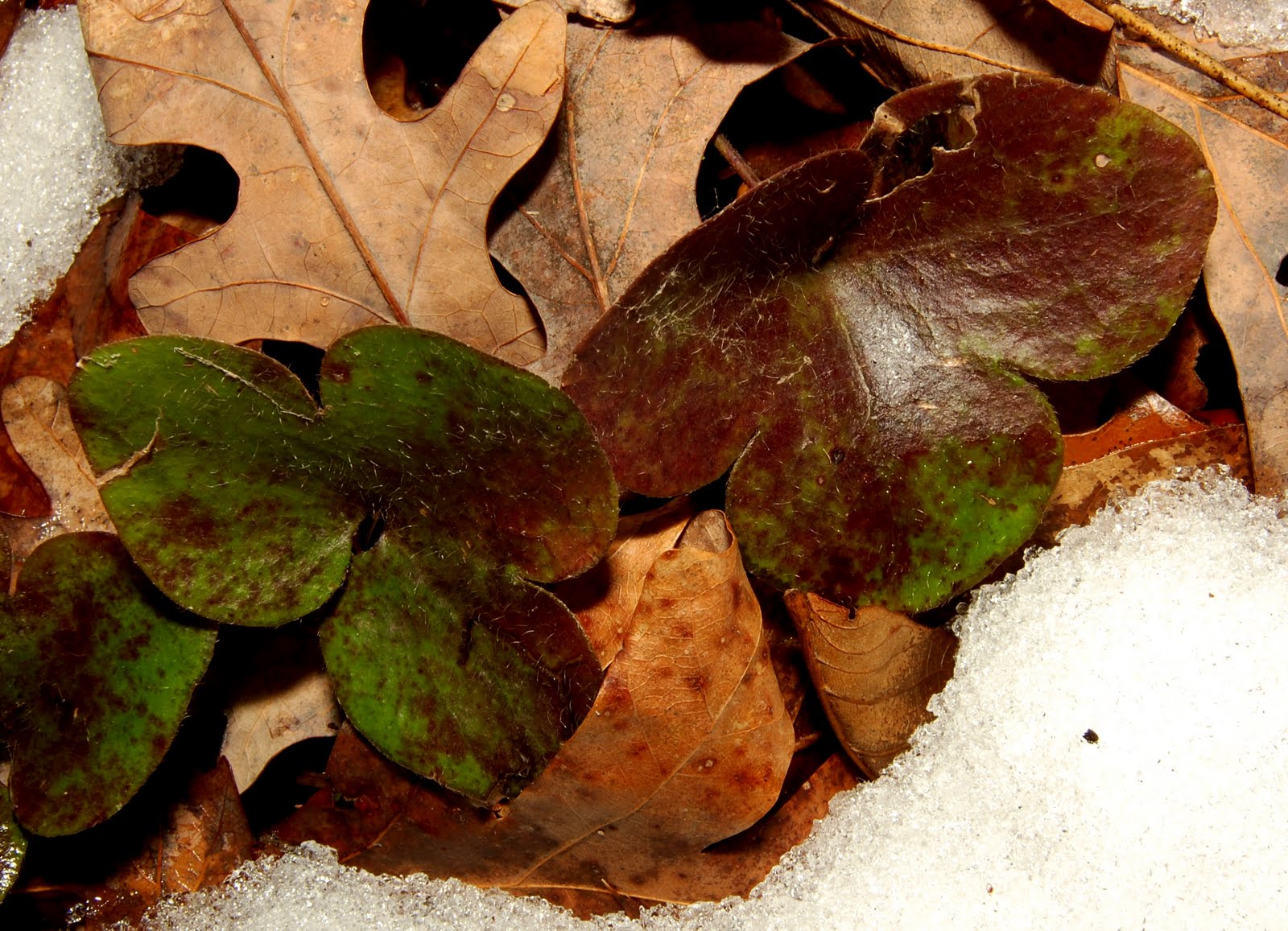
Hepatica americana is a colorful and attractive member of the Ranunculaceae (Crowfoot or Buttercup Family). It has a special affinity for rotting oak leaves and shaded, acid sandy soil. The dark green leaves have three rounded lobes, often mottled with deep maroon. Flowers open in very early spring and range in color from white through pink to purple. New leaves emerge as flowers fade away. Photographed in the Ardmore section of South Bend, Indiana in January, 2012.


Friday, January 13, 2012

Green in Winter: Monarda punctata, Plant Quiz Solved!

Congratulations to Andrew "The Commander" Blackburn for correctly identifying the winter leaves of Monarda punctata, Horse Mint. A common plant of dry sand in the dunes region of Indiana, this attractive mint produces pale yellow flowers with magenta spots (punctata = dotted). Upper bracts of the plant are pale pinkish or lavender and get a lot more attention than the flowers, which also are attractive. The entire plant has an extremely good minty smell, even the brunnescent, dried inflorescence in winter.

Posted earlier: Can you name this plant? It was photographed near Portage, Indiana on January 8, 2012. Good luck! I have no idea what the white blotches are on the leaves, but my guess is fungal growth.

This is how the plant looked in August, 2011 at Ogden Dunes, Indiana.

Thursday, January 12, 2012

Green in Winter: False Rue Anemone

Frequent in mesic woods, Isopyrum biternatum is one of the most abundant green plants in winter. In a very cold winter the leaves are mostly purple. It's a member of the Ranunculaceae (Buttercup Family) and its white flowers are a big part of the floral display in springtime woodlands. The flowers have no petals - just white petaloid sepals (aka "tepals")! Photographed at Bendix Woods County Park in St. Joe County, Indiana, on January 7, 2011.

This is how the plant looked in April, 2011 at Turkey Run State Park in west-central Indiana.

"The more thou learnest to know and enjoy, the more full and complete will be for thee the delight of living." Frances Theodora Parsons, 1899.